Product Discovery Just Left the Marketplace.
Good ideas travel faster when you share them; forward this to someone who’d find it useful.
Amazon built its entire business on one principle: keep the transaction on Amazon. Every design decision, every feature, every policy for 25 years pointed toward the same outcome — the buyer arrives, finds what they need, and completes the purchase without ever leaving. The idea of Amazon voluntarily sending a buyer to a competitor’s website would have been unthinkable a few years ago.
This week at CommerceNext, I learned that Amazon did exactly that.
Shop Direct — officially labeled “Shop other stores directly” in the Amazon app — surfaces products from independent merchant websites when a buyer searches for something Amazon doesn’t carry, then sends that buyer directly to the merchant’s site to complete the purchase. For eligible products, Amazon’s AI goes further: it completes the purchase on the buyer’s behalf, using their stored Amazon payment details, on a website Amazon doesn’t own or control.
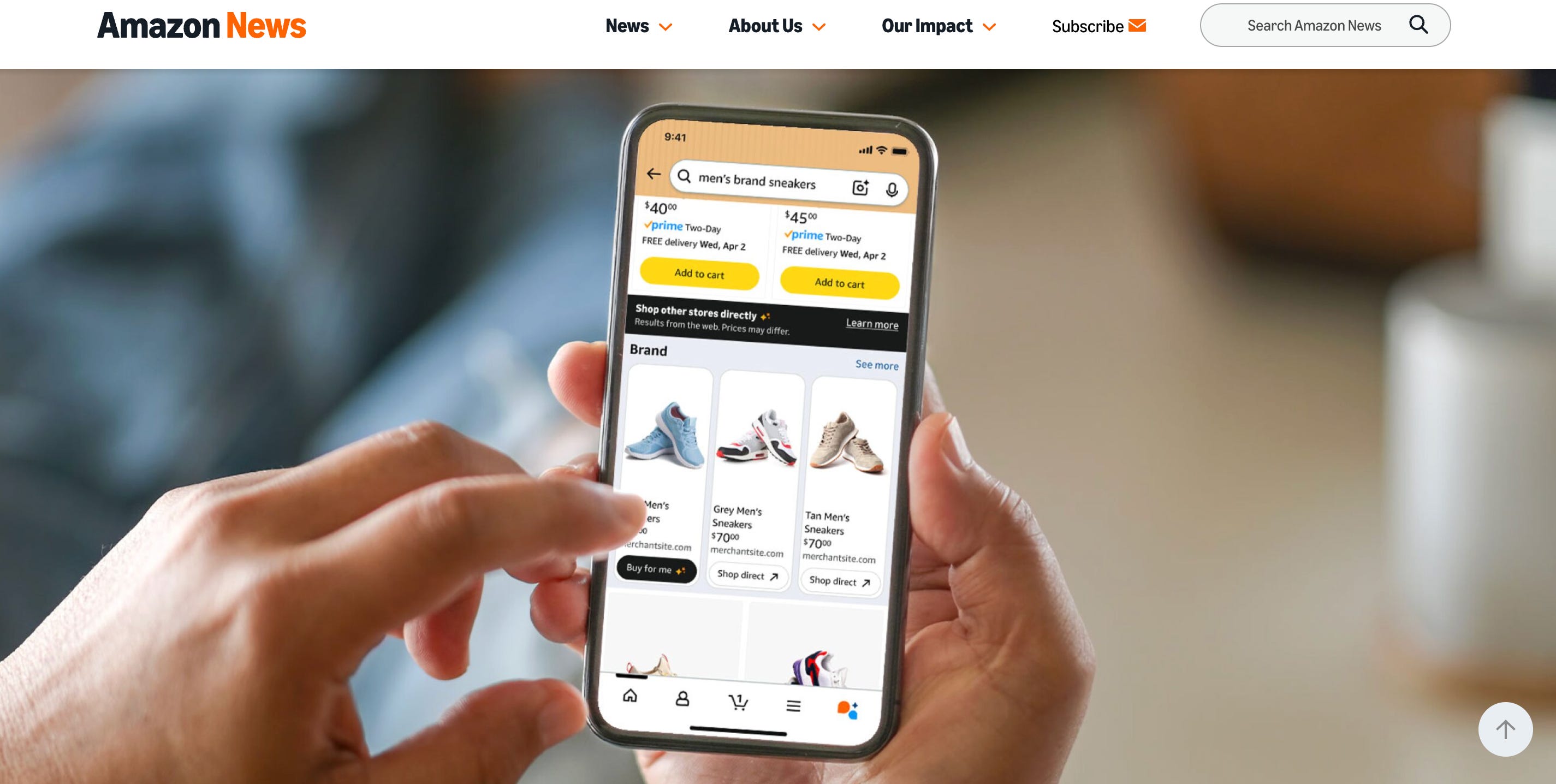
What Shop Direct looks like in the Amazon Shopping app.
Source: Amazon News · aboutamazon.com
The fact that Amazon was willing to build this at all suggests the economics of product discovery are changing in ways even the largest platforms cannot ignore.
What Amazon Actually Built
Shop Direct has two components that work differently and matter differently for merchants.
The first is a referral layer. When a buyer searches for a product Amazon doesn’t carry, they may see a section labeled “Shop other stores directly.” Clicking sends them to the merchant’s website to complete the purchase manually. Amazon earns nothing from the transaction — no commission, no fulfillment fee, no advertising revenue.
The second is more significant. A feature called Buy for Me takes this further — Amazon’s AI agent completes the purchase autonomously on the buyer’s behalf. The buyer confirms order details on Amazon’s familiar interface. Amazon’s AI then navigates to the merchant’s external website, enters the shipping and payment details, and finalizes the transaction. The merchant receives the order. Amazon retains the customer relationship.
Supply vs. DemandAmazon has disclosed supply metrics — 100 million products, 400,000 merchants. They have never disclosed demand metrics. No active user counts. No transaction volumes. No conversion rates. When Amazon launches something working, they publish the numbers quickly: Rufus reached 300 million users before its retirement. Buy with Prime delivered a 25% conversion lift. For Shop Direct, there are none of those numbers. The feature remains gated to a subset of US customers, primarily on mobile, triggered only for specific brand and niche queries. Shop Direct is better understood as infrastructure Amazon is building for the future of commerce than as a feature reshaping buyer behavior today.
How We Got Here
The March 2026 announcement of Shop Direct’s expansion to third-party feeds presented itself as a natural next step. The backstory is more instructive.
Initially, Amazon attempted to power Shop Direct through autonomous web scraping. Internal documents obtained by Business Insider revealed Project Starfish — an initiative using AI models to synthesize information from external websites to generate complete product information globally, with Amazon estimating it would collect data from 200,000 external brand websites. Independent merchants discovered their entire catalogs had been ingested and listed on Amazon without any agreement, notification, or opt-in.
The operational consequences were real. Merchants reported incorrect specifications, discontinued inventory still active, and AI-generated imagery that misrepresented their products. Amazon’s relay email system severed the direct communication chain between merchant and customer, breaking order tracking and returns management. Merchants in independent forums reported chargeback rates from Buy for Me orders severe enough to trigger payment processor reviews — well above the 1% threshold at which merchant accounts face penalties. The situation was compounded by a visible asymmetry: Amazon had simultaneously expanded its own robots.txt restrictions to block crawlers from Meta, Google, and OpenAI from accessing Amazon’s data, while its own bots harvested data from independent retailers.
The pivot to third-party feed syndicators — Feedonomics, Salsify, CEDCommerce — was not, in this reading, a strategic choice toward openness. It suggests Amazon recognized that clean, consent-based, merchant-controlled product data is the only foundation that makes agentic commerce function reliably. Even Amazon, with unlimited resources, could not shortcut the structured data requirement.
Amazon Wasn’t the First. They Were the Last.
Here’s what makes this moment significant. Amazon didn’t invent the feed-driven product discovery model. They resisted it longer than anyone — and then adopted it when buyer behavior left them with diminishing alternatives.
Google built the original version in 2010. Google Shopping introduced feed-driven product cards directly in search results. Merchants who submitted structured product data appeared. Merchants who didn’t were invisible — regardless of brand recognition, catalog size, or advertising spend.
Meta followed with Facebook and Instagram Shops — the same architecture across both platforms. A structured product catalog feed powers what gets shown, to whom, and when.
Then came the AI platforms. ChatGPT launched its Agentic Commerce Protocol in 2024 — structured product feed, product cards surfaced in response to shopping queries, discovery driven by data quality not domain authority. Perplexity launched its merchant program the same year, with product feed submission giving it structured catalog data and Buy with Pro checkout enabling purchases without leaving the platform. Microsoft Copilot integrated native shopping feeds directly into its chat interface. Amazon’s Alexa for Shopping — which replaced the standalone Rufus chatbot entirely on May 13, 2026, embedding AI directly into the main Amazon search bar for every signed-in US customer — followed the same architecture.
The interface evolved from a search bar to a chat window. The required fuel remained identical: a clean, structured product feed.
Five platforms. Three different business models. One architecture. None of them coordinated.
None of these companies coordinated. They each followed where buyer behavior was going. Amazon is the last major platform to join — and the evidence points toward one interpretation: there is no way around the structured data requirement, regardless of resources or market position.
The Buyer Journey Has Split in Two
To understand why this convergence matters for merchants, you need to understand how buyers actually search today. The assumption most merchants operate on — that buyers go to Google or Amazon first and AI tools come later — is no longer accurate for a growing share of transactions.
Stage 1 - Discovery
2.6×
AI tools beat traditional search at the discovery stage — 35% of users prefer AI for initial product ideas vs. 13.6% for search engines
Similarweb US Market Research Panel, Jan 2026 · users of both AI and search
Stage 1 - Transaction
37%
of consumers now initiate their shopping journey inside an AI prompt rather than a traditional search engine
2026 AI + Search Behavior Study · 500 active AI users surveyed
The journey has not compressed into one step. It has split into two distinct stages — a role separation that is currently stable but actively narrowing as platforms collapse discovery and transaction into single surfaces.
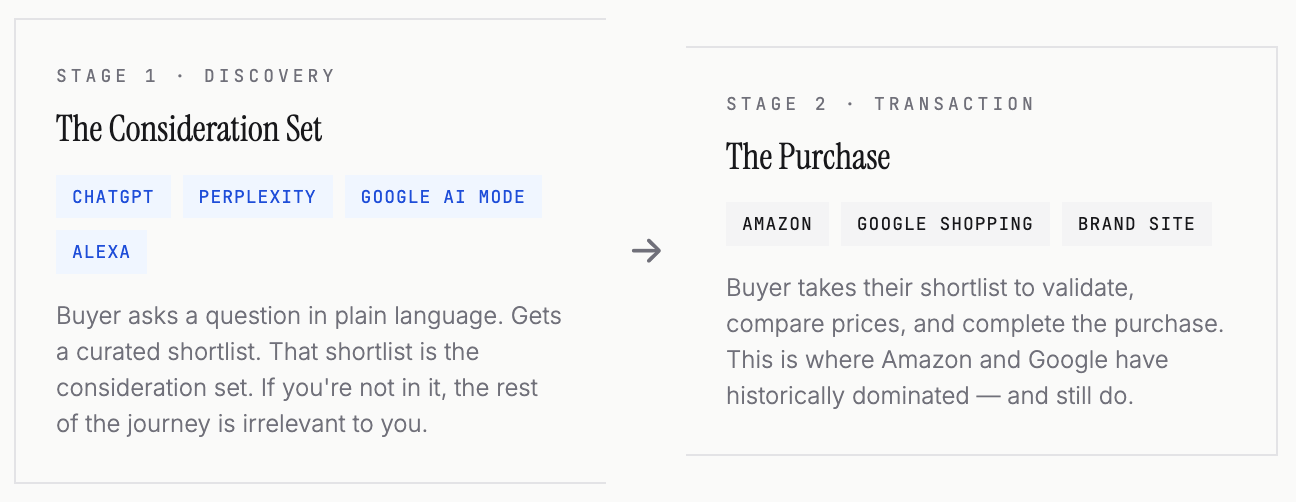
The boundary between these two stages is narrowing — but for most merchants today, the gap between them is where the opportunity and the risk both live.
The implication is precise: being invisible in stage one means never making the consideration set. It doesn’t matter how strong the Amazon listing is or how well-optimized the Google Shopping feed is. If the merchant didn’t appear when the buyer was forming their shortlist, they were never in the running.
What I Heard at CommerceNext
I spent two days at CommerceNext this week in conversations with ecommerce and catalog leaders across some of the largest brands, retailers, and technology platforms in the country. Over the past several months I’ve been studying how products surface across AI shopping experiences, testing discovery behavior across multiple platforms. The overarching takeaway from the conference floor: there is a significant gap between the AI solutions being pitched in the expo hall and the operational reality inside catalog departments.
A head of AI at one of the largest pet retailers in the country described a problem most people in the room recognized immediately: their team built a multi-year AI visibility strategy, secured executive backing, ran extensive experiments — and still cannot demonstrate clean ROI on AI-driven discovery. The program continues because leadership is unwilling to cede ground to competitors, not because the measurement problem is solved. That tension — investing in a channel you know matters before you can prove it definitively — was the most common theme across every conversation I had. It supports one clear reading: the measurement infrastructure for AI commerce is at least one cycle behind the investment decisions being made.
The feed management platforms named as Amazon’s launch partners for Shop Direct were present at the conference — confirming that the infrastructure layer for feed distribution is consolidating around a small number of players. The data quality layer above it remains largely unsolved, which is where the next set of conversations is heading.
The Amazon team at the conference was there to sell Shop Direct feed participation to merchants — confirming that supply-side adoption is the current priority for the program. The demand side remains undisclosed, consistent with the metric pattern described above.
One pattern worth flagging: a number of website search providers were actively positioning their products as AI visibility solutions. The conflation of on-site search optimization and AI discovery eligibility is a category confusion worth watching carefully. They are fundamentally different problems with different solutions, serving different stages of the buyer journey described above.
What This Means For Merchants
Every platform covered above — Google, Meta, ChatGPT, Perplexity, Amazon — independently arrived at the same architecture. None of them coordinated. They each followed where buyer behavior was going.
These systems don’t crawl and guess like a search engine. They ingest and match based on what the feed tells them. The cleaner, richer, and more clearly structured the data, the more often products show up in relevant AI shopping experiences.
The merchants appearing consistently across these platforms share one thing. It isn’t budget. It isn’t brand recognition. It isn’t catalog size. It’s that their product data is structured in a way these systems can read, understand, and act on. The merchants who are invisible share one thing too. It isn’t that their products are inferior. It’s that their data isn’t.
Merchants don’t need to optimize for Amazon, ChatGPT, Perplexity, and Google separately. They need a single source of structured, enriched, machine-readable product data. That single source is what determines whether they appear in stage one — the consideration set — or not at all.
McKinsey projects AI-powered search will impact $750 billion in consumer spending by 2028. The supply side of this infrastructure is being built now. The demand side will follow as AI shopping assistants mature and buyer behavior continues to shift.
Amazon spent twenty-five years trying to own every transaction. The fact that it is now willing to send buyers elsewhere may be the clearest signal yet that product discovery is moving beyond any single marketplace’s control.
The New Shelf · Platform Series
This is the first in a series breaking down every platform and every surface where buyers find products today — in depth, one platform at a time.
No. 1 — Amazon and the convergence signal
No. 2 — Every platform, every surface: the full map
No. 3 — Google: seven surfaces, one feed
No. 4 — Amazon: the full picture
No. 5 — ChatGPT / OpenAI
No. 6 — Meta
No. 7 — Microsoft
No. 8 — Perplexity
Sources
Amazon News — Shop Direct official announcement
https://www.aboutamazon.com/news/retail/amazon-shop-direct-external-storesAmazon News — Buy for Me feature announcement
https://www.aboutamazon.com/news/retail/amazon-shopping-app-buy-for-me-brandsBusiness Insider, 2024 — Project Starfish internal documentation
(Reported claim based on internal documents obtained by Business Insider. Amazon’s internal initiative to harvest product data from external merchant websites using AI crawlers.)Surebright — Amazon Buy for Me chargeback analysis
https://www.surebright.com/blog/amazon-buy-for-me-the-chargebacks-are-just-the-beginningChain Store Age — Amazon Shop Direct feed expansion
https://chainstoreage.com/amazon-opens-shop-direct-feature-third-party-product-feedsAmazon US Press Center — Buy with Prime conversion data
https://press.aboutamazon.com/2023/1/amazons-buy-with-prime-increases-shopper-conversion-by-an-average-of-25Recent consumer behavior research on AI vs. search preference at discovery stage, 2026. Multiple independent panels point to a consistent shift toward AI-first shopping initiation.
2026 AI + Search Behavior Research. Independent consumer study on shopping journey initiation behavior.
McKinsey — AI commerce revenue impact projection. AI-powered search projected to impact $750 billion in consumer spending by 2028.
How does AI search see your store right now?
We run real category queries across ChatGPT, Perplexity, and Google AI Mode, inspect your catalog representations, and send you a plain-language report. Completely organic; we never ask for logins or ad spend.
Request your report
Two fields. A person reviews it and emails you back within 48 hours.