I Met With the Companies Building AI Visibility Tools. The Most Honest Answer Was: Nobody Knows Exactly What's Working Yet.
In my last piece, I mapped the AI visibility market into three camps: monitoring, content generation, and catalog enrichment. The observation that stayed with me after writing it: the third camp — catalog enrichment — had the fewest vendors, and most of what I'd seen was still operating at the GEO and AEO layer. Publishing content, building topical authority, optimizing for brand mentions in AI responses.
I wanted to understand that gap better. So over the past week I sat down with several of the companies building in this space — tools across the monitoring, enrichment, and data intelligence categories. I went in with a specific question: not what their product does, but what their customers are actually telling them is working.
The honest answer, across almost every conversation, was some version of the same thing: we’re all still figuring it out.
That’s not a criticism. It’s the most useful thing I learned.
The finding that genuinely surprised me
I went into these conversations believing one thing with reasonable confidence: that actual user query data — the specific phrases buyers type into ChatGPT or Perplexity before landing on a product — was essentially unknowable. Unlike Google, which has leaked enough signal over the years to build an entire keyword research industry around it, AI platforms don’t expose query data. There’s no AI equivalent of Google Search Console. You can see that traffic came from ChatGPT. You cannot see what the person typed to get there.
Or so I thought.
One conversation introduced me to an approach I hadn’t considered — using web intelligence data to approximate the types of queries driving AI platform traffic. I can’t fully validate the methodology from a single conversation, and I want to be careful not to overstate what this is. But the directional concept is worth sitting with: if query behavior can be approximated even roughly, it changes how you think about enrichment prioritization.
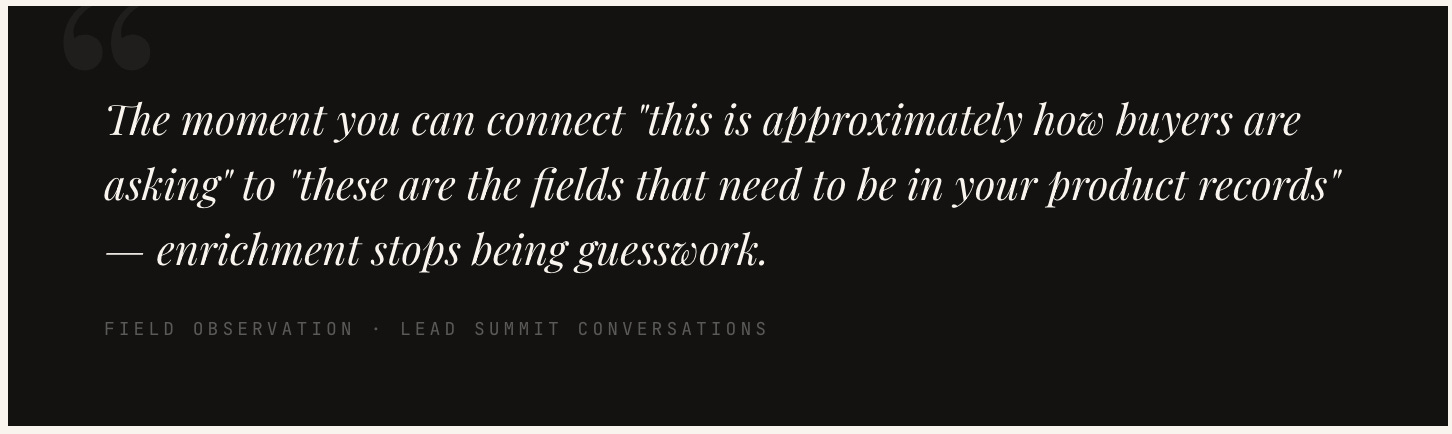
The implication is significant. Whether the current methodology is mature enough to drive that loop in practice is something I intend to investigate further. But the concept alone is the most thought-provoking thing I encountered across all five conversations.
I want to be precise about what this means in practice. LLMs don't retrieve products the way a database query matches fields — they reason over semantic meaning using dense vector embeddings. That means the connection between specific buyer language and specific catalog fields is probabilistic, not deterministic. Query intelligence narrows the enrichment target. It doesn't guarantee the outcome. That distinction matters when you're making decisions about where to invest enrichment effort.
The measurement problem is worse than I thought
Here’s why that query intelligence finding matters so much: the measurement infrastructure that would make AI visibility legible simply doesn’t exist yet — and the gap is larger than most vendors acknowledge publicly.

AI visibility as a measurable channel has perhaps two to three years of meaningful data — and even that is fragmented across platforms that each behave differently. ChatGPT, Perplexity, and Google AI Mode are not just different products. They have different retrieval architectures, different feed requirements, different ranking signals. Retrieval behavior can shift between measurement sessions, sometimes within days.
The companies I spoke with are building measurement infrastructure in real time, on a system that is itself changing in real time. That’s not a criticism of the vendors — it’s the honest condition of a genuinely new market. But it is important context for anyone evaluating AI visibility tools right now. Claims of attribution and causality should be held lightly. The honest vendors said as much themselves. In my view, the ones to be cautious about are the ones who didn’t.
The marketplace enrichment angle nobody is talking about
Most of the AI visibility conversation centers on the big three platforms — ChatGPT, Perplexity, Google AI Mode. That’s where the visibility demos are. That’s where the early case studies are being built.
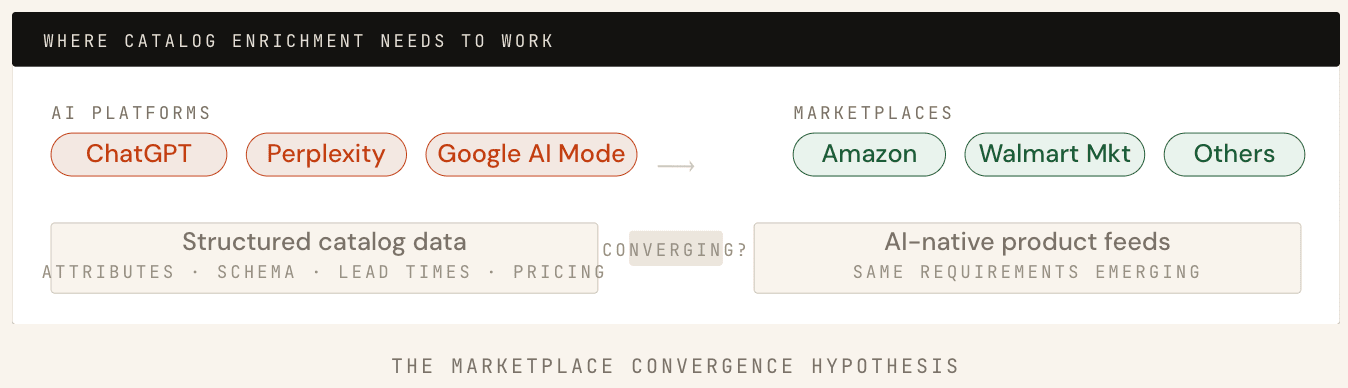
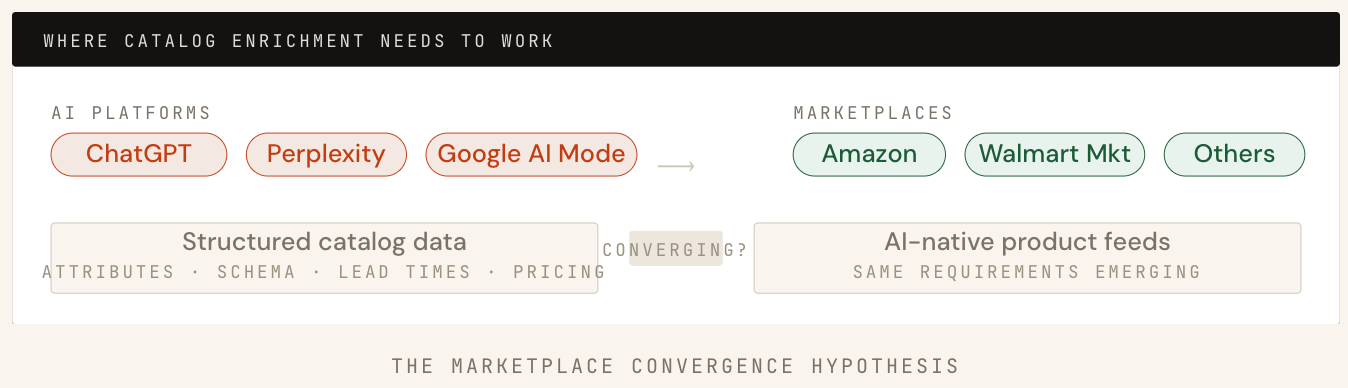
What I didn’t expect to hear was a hypothesis that at least one conversation made a compelling case for: applying catalog enrichment logic to marketplace feeds as well. The argument is that AI-native discovery is coming to Amazon, Walmart Marketplace, and similar platforms — and the product data requirements for AI-powered marketplace search may converge with the requirements for external AI platform visibility.
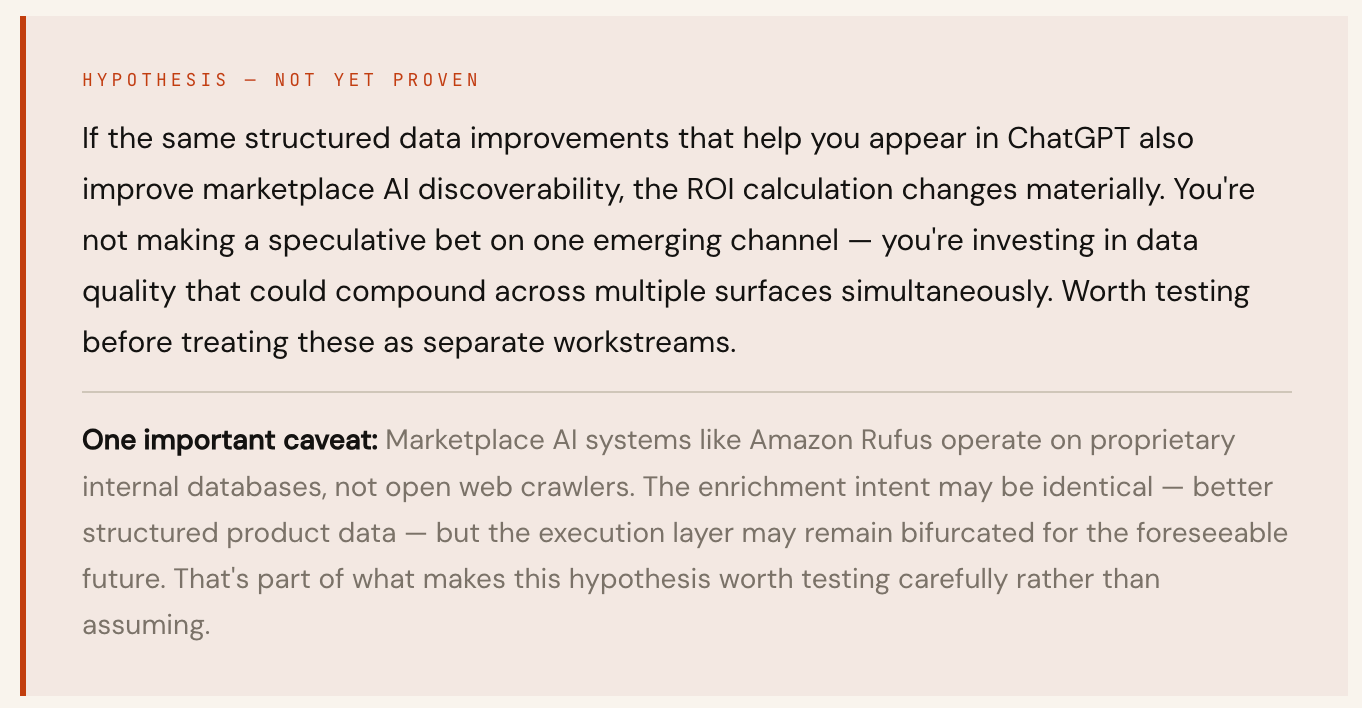
I haven't seen data that proves this yet. But for catalog-heavy businesses running separate workstreams for AI visibility and marketplace optimization, the structural logic is worth examining closely.
What nobody knows yet — and why that’s the honest answer
The most consistent theme across every conversation wasn’t a product feature or a technical capability. It was an absence: almost no one has published credible case studies showing a direct causal link between specific enrichment decisions and measurable citation lift.
This isn’t because the tools don’t work. It’s because the space is new enough that the before-and-after data is still being collected. The companies doing the most rigorous work are running controlled experiments right now. The results are weeks or months away.
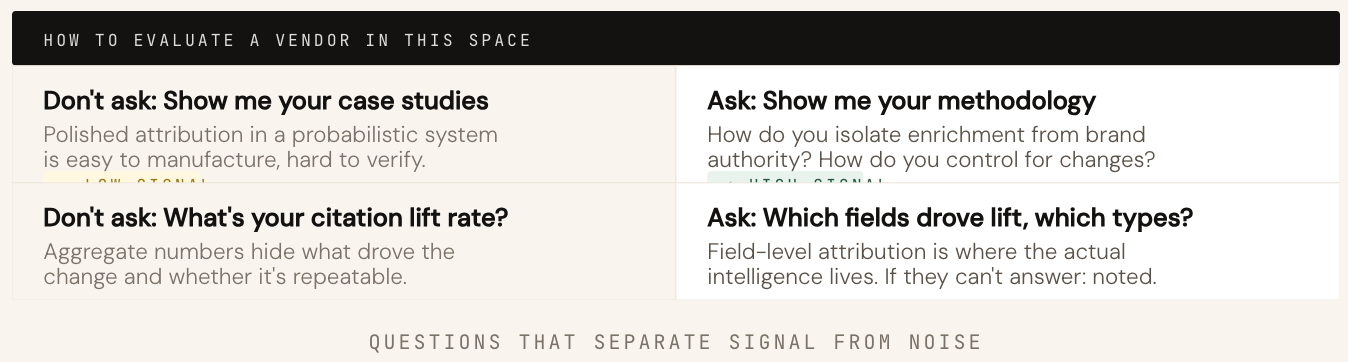
In my view, vendors who already have polished case studies with clean attribution numbers deserve more scrutiny, not less — because that level of precision in a probabilistic, rapidly changing AI retrieval system is genuinely difficult to produce honestly. The question worth asking isn't "show me your case studies." It's "show me your measurement methodology." How do you isolate the effect of enrichment from brand authority? How do you control for platform changes between measurement periods?
Where the teaser from last time actually leads
I promised in my last piece that the field driving citation lift in one query type doesn’t necessarily help — and may not help — in another. I’m still building toward the full data release on that. The controlled experiment I’ve been running needs a few more weeks to produce results worth publishing.
But the directional logic is worth explaining now, because the conversations I had this week made it clearer.
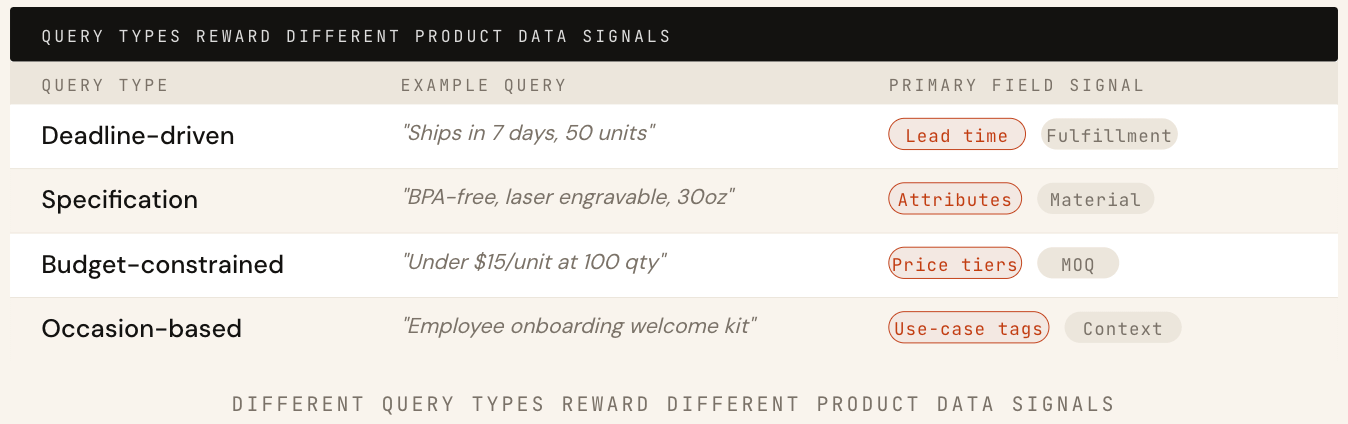
My early data suggests that the fields correlating with citation lift on one query type don’t necessarily help on another — and the relationship isn’t linear. Whether over-optimizing for one query type actively suppresses performance on others is something the data will need to confirm. But the directional implication is clear enough to state now: enriching without knowing which query types your actual buyers are running is optimizing toward your assumptions. And your assumptions may be wrong.
The full data is coming. For now, treat this as a framing worth holding.
What I’d do if I were running an AI visibility program today
Given the measurement gap, the query intelligence opportunity, and the honest state of the vendor landscape — here is what I'd prioritize if I were building this from scratch right now.
01 Start with catalog quality, not content volume
The content generation tools are compelling and well-priced. But for a business with thousands of SKUs, blog posts don't move the needle on product-level AI retrieval. Get your product records structured first. Everything else depends on that foundation.
02 Track citation changes at the field level, not just brand level
Knowing your brand mentions went up 12% last month tells you almost nothing useful. Knowing that your citation rate on deadline-driven queries improved after you added structured lead time data — that's actionable intelligence.
03 Run controlled experiments before scaling anything
Change one variable at a time. Enrich a subset of your catalog, hold the rest as a control, run the same buyer-intent queries against both. Without a control group, you can't distinguish enrichment lift from platform drift. One important constraint: LLMs are probabilistic engines. Running a query once tells you almost nothing — running it ten to twenty times across multiple sessions and looking for consistent patterns is the minimum for a meaningful signal. When I say "controlled experiment," I mean repeated-query protocol, not a single-check comparison.
04 Ignore vendor attribution claims without a clear methodology
Ask every vendor the same question: how do you isolate the effect of your product from organic platform improvement? If they can't answer it clearly, that's your answer.
05 Build your own measurement database, even a simple one
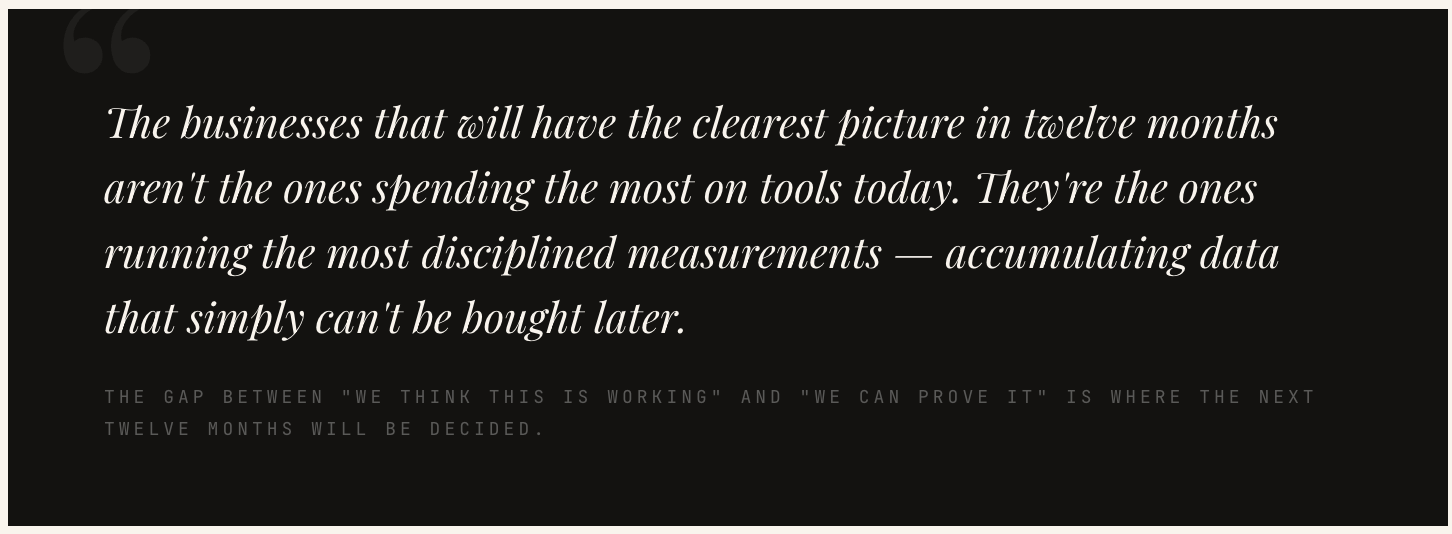
Run the same ten to twenty buyer-intent queries every two weeks. Record what appears. Track changes over time. In twelve months, that longitudinal dataset will be more valuable than any vendor dashboard — because it's specific to your vertical and your buyers.
Where this is all heading
Right now, every company operating in AI visibility is working with incomplete maps. The terrain is changing faster than the cartography. The vendors building the most credible tools are the ones acknowledging this openly. The ones to watch carefully are the ones who aren’t.
That’s actually an encouraging signal for where the market is heading. When the most sophisticated players in a category are honest about the limits of their own knowledge, it usually means the foundational work is being done carefully — not rushed to market with claims that outrun the evidence.
I'll have more on that in the next piece — with actual numbers.
DATA SOURCES
Referral traffic statistics: Conductor 2026 Benchmarks, SE Ranking, Semrush, Ahrefs. Conversion rate data: Ahrefs June 2025, Semrush 2025 AI Search Study. Market share data: eMarketer, BrightEdge 2026. Funding data: Crunchbase, company announcements, press releases. Zero-click statistics: BrightEdge, Search Engine Land 2026. GEO market projections: eMarketer 2026 Forecast, McKinsey 2025.
Disclosure
The author works at the intersection of AI commerce and B2B catalog infrastructure. Some findings referenced are drawn from original research conducted over the past 30 days on AI visibility patterns in B2B ecommerce. No affiliated companies are named or promoted in this article.
How does AI search see your store right now?
We run real category queries across ChatGPT, Perplexity, and Google AI Mode, inspect your catalog representations, and send you a plain-language report. Completely organic; we never ask for logins or ad spend.
Request your report
Two fields. A person reviews it and emails you back within 48 hours.