I Promised Data. Here It Is. Some of It Confirmed What I Expected. Some of It Didn't.
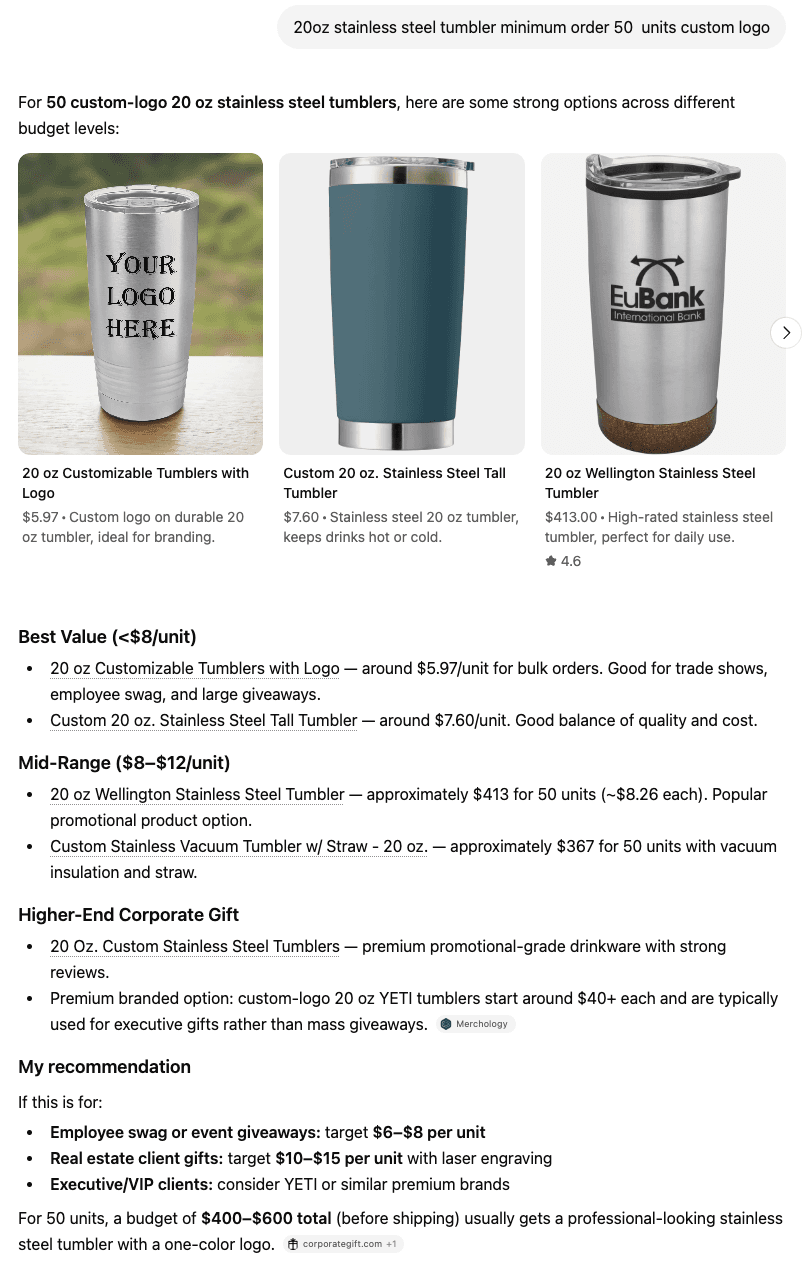
Three findings from six weeks of measurement surprised me enough to write about them now rather than wait.
Production time — how long it takes to produce and ship an order — emerged as the most frequently cited product field in the dataset, rising from 40% citation rate at baseline to 95% by the final session. Minimum order quantity, the most B2B-specific field I tracked, declined over the same period. And the experiment pages I built specifically to test enrichment never showed up in any AI response across 360 observations. That last one is the finding I want to be most honest about.
In my last piece, I said the numbers were a few weeks away. I also made a claim worth revisiting: that the field driving citation lift in one query type doesn’t necessarily help in another. The data now lets me say something more concrete about that.
The experiment ran 20 structured buyer-intent queries across ChatGPT, Perplexity, and Google AI — five measurement sessions from mid-May through early June, covering the full range of how a corporate buyer actually searches: specification queries, deadline-driven queries, occasion-base
d queries, budget queries, comparison queries, and negative-constraint queries — things like “drinkware that doesn’t look like a giveaway.” These findings should be read as directional rather than universal. The dataset covers one product category, one vertical, and five measurement windows. Additional testing across categories and larger query sets is needed before treating these relationships as platform-wide behavior.
I scored each response on a 0-to-4 scale:
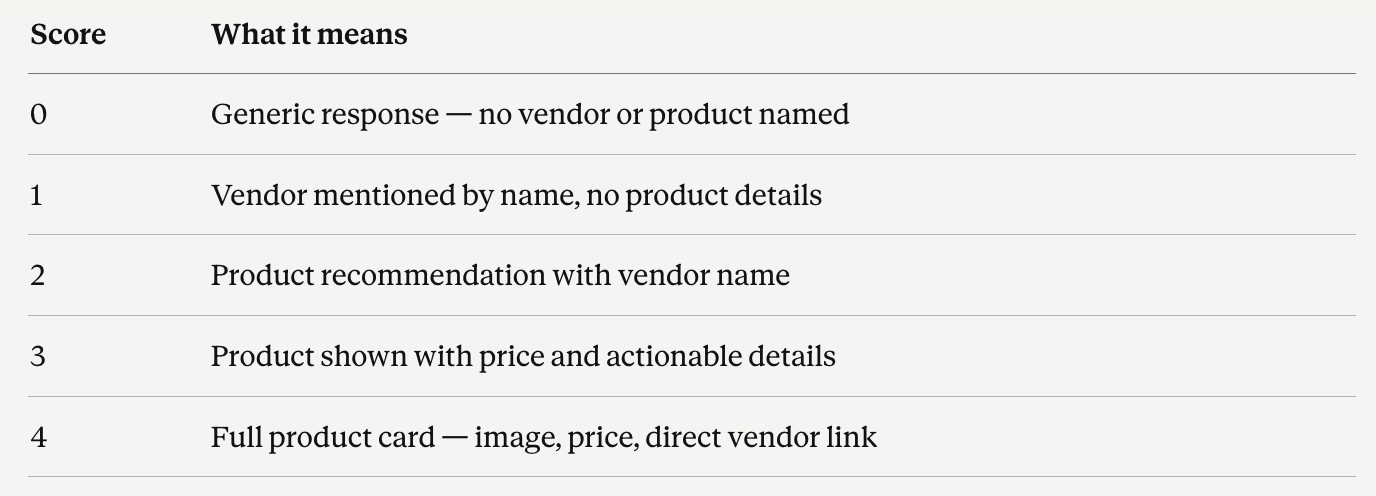
Scores were assigned manually against this rubric for each query-platform-session combination, producing 360 total observations across the five sessions.
Here’s where each platform landed.
ChatGPT opened at a perfect 4.0 — every query returned a full product card. By the end of the experiment it had settled at 3.60, recovering from a notable dip in week two that I’ll come back to. Google AI Mode climbed steadily from 2.50 to 2.65. Google’s traditional search with AI Overviews debuted at 2.70 in week three and reached 2.90 by June, surpassing Google AI Mode to become the strongest-performing Google surface in the dataset.
The platform trajectories matter less than what’s underneath them.
The field I didn’t expect to matter most
I was tracking not just which vendors appeared, but which specific product data fields appeared in the AI responses — the actual attributes being cited across all responses, regardless of which vendor was shown.
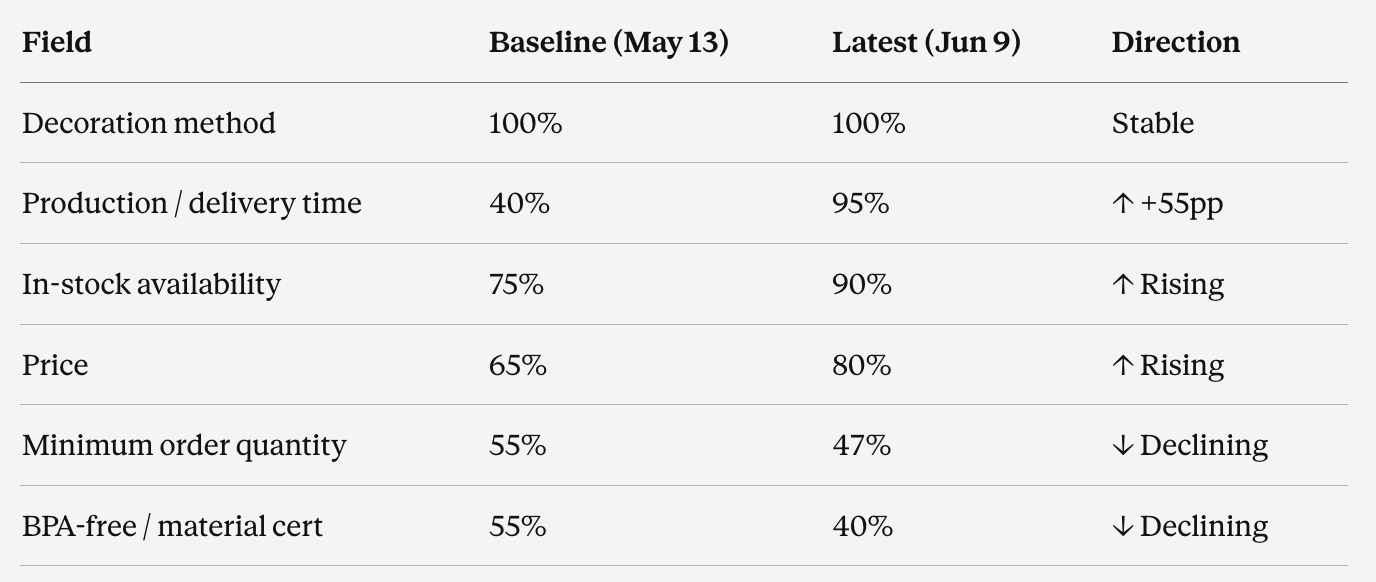
Production time started the experiment with a 40% citation rate. By the final session it had reached 95%.
A vendor who states “standard production 7 business days, rush 3–4 days” directly on their product page is now showing up in deadline-driven queries that a vendor without that data simply isn’t winning. A vendor with the same product who buries turnaround time in a FAQ or leaves it unstated is invisible to that class of query entirely.
MOQ moving in the opposite direction is the finding I keep returning to. MOQ is the most B2B-specific data field in the set — it has no real consumer equivalent. Production time exists in every retail category. And yet AI platforms are increasingly surfacing production time and moving away from MOQ as a primary citation signal.
One plausible explanation: deadline language is everywhere in B2B procurement. “Can you ship in seven business days,” “need this for an event in three weeks,” “what’s the fastest turnaround.” Those queries map directly to production time data when it’s structured and present. A hypothesis consistent with the data is that AI systems are learning to answer the questions buyers are actually asking, and deadline questions have become more common than minimum quantity questions as the primary search intent. Whether that’s causal or whether AI systems are simply getting better at extracting all structured product information equally is something I can’t determine from this dataset alone.
One field has been rock-solid at 100% citation rate across every single session: decoration method — whether a product can be laser engraved, screen printed, or digitally imprinted. This appeared in AI responses without exception, even in sessions where other fields dropped. The reason, I think, is structural: decoration method is the primary differentiator in this category. When a buyer asks for a “laser-engraved tumbler,” the AI has to surface that field to give a useful answer at all. It’s not optional context. It’s the answer. That makes it different from fields like MOQ or setup fee — fields that matter in a transaction but aren’t what buyers lead with in a query.
What the week-two crash actually proved
In the third week of measurement, ChatGPT’s score dropped from 3.65 to 2.15 in a single session. Zero confirmed product cards. The responses still named companies and products, but the vendor links were gone. The AI had shifted from serving shopping results to serving advisory essays.
I confirmed within a few days that this was a temporary platform change, not a catalog problem. The feeds came back. But that window revealed something I hadn’t expected to see so clearly.
Without the structured feed, the quality of responses visibly degraded. Queries that had been returning specific products with prices and direct vendor links were now returning paragraph-length explanations of what to look for in a supplier. A buyer asking “what branded tumblers can ship in seven days” went from getting a product card with a price and a link to visit the supplier directly, to getting a paragraph about what to consider when evaluating turnaround time. Useful, maybe. Actionable, much less so.
This distinction matters for how you think about what AI visibility actually is. There are two layers operating in parallel: AI responses that mention your brand or category in prose, and AI responses that serve your actual products as a result a buyer can act on immediately. The second layer is strongly associated with structured feed participation in this dataset. The first layer exists with or without it, but it doesn’t convert. The week-two crash was a natural experiment in what the second layer is worth — and the answer was substantial.
The finding I want to be most transparent about
The enriched pages I built for this experiment never appeared in any AI response across the entire measurement period.
Not once, across 360 observations, on any platform.
I want to be precise about what this means, because the honest interpretation is different from the obvious one. This is not a null result on enrichment. The enrichment methodology is grounded in real field citation data — the production time finding, the decoration method finding, these came from observing which fields appeared in AI responses for vendors who are already winning. What the non-appearance of my test pages tells me is something more specific: enrichment alone, deployed on a newly created domain, was not sufficient for AI citation in this experiment. Whether the gating factor is domain authority, indexing maturity, crawl frequency, entity recognition, or some combination of these is an open question the data can’t resolve. What it does establish is that deployment context matters — a finding that changes how I think about where enrichment interventions actually belong.
Running the experiment on fresh pages was methodologically clean for isolating the enrichment variable. It was also exactly the wrong condition for demonstrating citation lift. If I ran the same enrichment on a vendor’s existing, already-indexed domain, the result would likely be different. I intend to find out.
For now: the enrichment thesis is supported by the field citation data. The deployment context matters enormously.
The structural finding that changes how you think about AI competitive strategy
The most consequential thing I observed across five sessions has nothing to do with any single field. It’s the composition of who appears where — and why.
The winners on ChatGPT got there through data structure. The winners on Google got there through data structure and content — product pages that answer the questions buyers are actually asking, in language buyers actually use.
A laser-engraving specialist with 200 products was outranking a national distributor with 50,000 on ChatGPT. Not because of brand recognition. Because their product data was structured correctly — the right fields, in the right format, submitted through the right feed. Feed inclusion is the leading explanation for the observed ChatGPT visibility differences in this dataset, though this study was not designed to isolate feed participation from other platform-specific ranking factors. On Google’s surfaces, that same national distributor was dominant — because years of indexed content, buyer guides, and occasion-tagged product pages had built the trust signal that Google rewards. Two different competitive arenas. Two different currencies.
One of the most recognizable distributors in the category I was studying appears consistently on Google Search and Google AI Mode. It has zero confirmed product card appearances on ChatGPT across all five sessions. Smaller stores with no comparable brand recognition are appearing on ChatGPT ahead of them in every session — because those stores have a structured product feed and the national distributor doesn’t.
The structural point isn’t that one platform is better than another. It’s that a company can dominate three AI surfaces and be completely invisible on a fourth — and not know it, because they’re measuring brand mentions rather than surface-specific eligibility. Think of it this way: if you searched for your own company on ChatGPT right now and saw your name in the response, you might assume you have ChatGPT visibility. But a brand mention in prose and a product card with a vendor link are two entirely different outcomes for a buyer. One ends in a tab open to your site. The other ends in a recommendation to look you up. The first question worth asking isn’t “how do we improve our AI visibility.” It’s “which surfaces are we even eligible to appear on, and why.”
What that means in practice: audit each surface separately. Check whether your products appear as cards on ChatGPT — not whether your brand name appears in a response. Check whether your pages are indexed by Bing, not just Google. Check whether your Google Shopping feed is active and whether it’s appearing in AI Overviews. These are distinct eligibility questions, and answering “yes” to one doesn’t tell you anything about the others.
The specialist trend that didn’t stop
Week over week, I watched something consistent: within this dataset, specialist vendors — companies with narrow catalog depth and exceptional data quality in a specific category — appeared more frequently in AI responses than broad-catalog distributors with adequate data quality across many categories.
AI systems appear to reward concentration. A distributor with 200 deeply enriched products in one category — detailed specs, structured delivery times, use-case language, occasion tags — consistently appeared more often than one with 5,000 thinly documented products across many. I tracked total appearances across platforms, not a controlled specialist-vs-generalist comparison, so I’d caution against reading this as a precise measurement. The directional signal was consistent across sessions; the magnitude of the difference is something a larger study would need to quantify properly.
The winning specialist pages also weren’t just better structured. They were richer in the kind of content that answers buyer questions directly: FAQ pairs, occasion-specific language, quality signals in the product description itself. That combination — structured data plus buyer-intent content — is what separated them from the generalists losing ground, on the crawl-based surfaces at least.
Where this leaves me
I set out to measure which product fields drive AI citation lift. The data gave me a cleaner answer on some fields than I expected, and a more complicated answer on platform dynamics than I was prepared for.
Production time emerged as the most frequently cited field, rising from 40% to 95% across the experiment. Decoration method was universal and structural. MOQ declined. Enrichment on a new domain produced no citations. Platform-specific eligibility gates mean that visibility on one AI surface tells you almost nothing about visibility on another. And the competitive landscape on new AI surfaces is being built right now by players with better data structure and buyer-intent content — not necessarily by the companies with the most brand recognition or the widest catalogs.
The next phase is running the same enrichment protocol on an established domain — which is where the intervention belongs in practice. If the deployment context hypothesis holds, the difference in citation lift should be visible within a few sessions.
I’ll report back with the actual numbers.
The author works at the intersection of AI commerce and B2B catalog infrastructure. Findings referenced are drawn from original research conducted over six weeks on AI visibility patterns in B2B ecommerce across one product category and vertical. No affiliated companies are named or promoted in this article.
How does AI search see your store right now?
We run real category queries across ChatGPT, Perplexity, and Google AI Mode, inspect your catalog representations, and send you a plain-language report. Completely organic; we never ask for logins or ad spend.
Request your report
Two fields. A person reviews it and emails you back within 48 hours.