Nobody Owns the Layer Between Your Shopify Store and AI
Good ideas travel faster when you share them; forward this to someone who’d find it useful.
In Part 1, we showed that the wall exists between what a Shopify store’s catalog knows about its products and what external systems can actually see. The basic product identity gets through. The rich attributes don’t.
In Part 2, we opened the feed and found four types of failure hiding behind one symptom: products that never left the catalog, products that left incomplete, data that changed in transit, and representations that contradicted each other.
The more interesting question is whose job it is to manage that layer.
By “layer,” we mean everything that determines what leaves Shopify and how: structured data, metafields, feeds, policies, identifiers, availability signals, and the rules that keep those representations consistent. Your Shopify store has a source of truth. But AI doesn’t see your source of truth. It sees the representations that leave it.
On Flaunt Your Ink (FYI), a D2C tattoo aftercare and men’s grooming brand on Shopify, we mapped every layer to an owner. The catalog had one. The feed had one. The theme had one. The layer between all three, the cross-surface consistency layer, had nobody.
We know this because we eventually became the ones who filled it. What follows is what falls through that gap, what it took to close it, and how to check whether you have the same problem.
We went into this engagement with a set of assumptions. They were wrong in an instructive way.
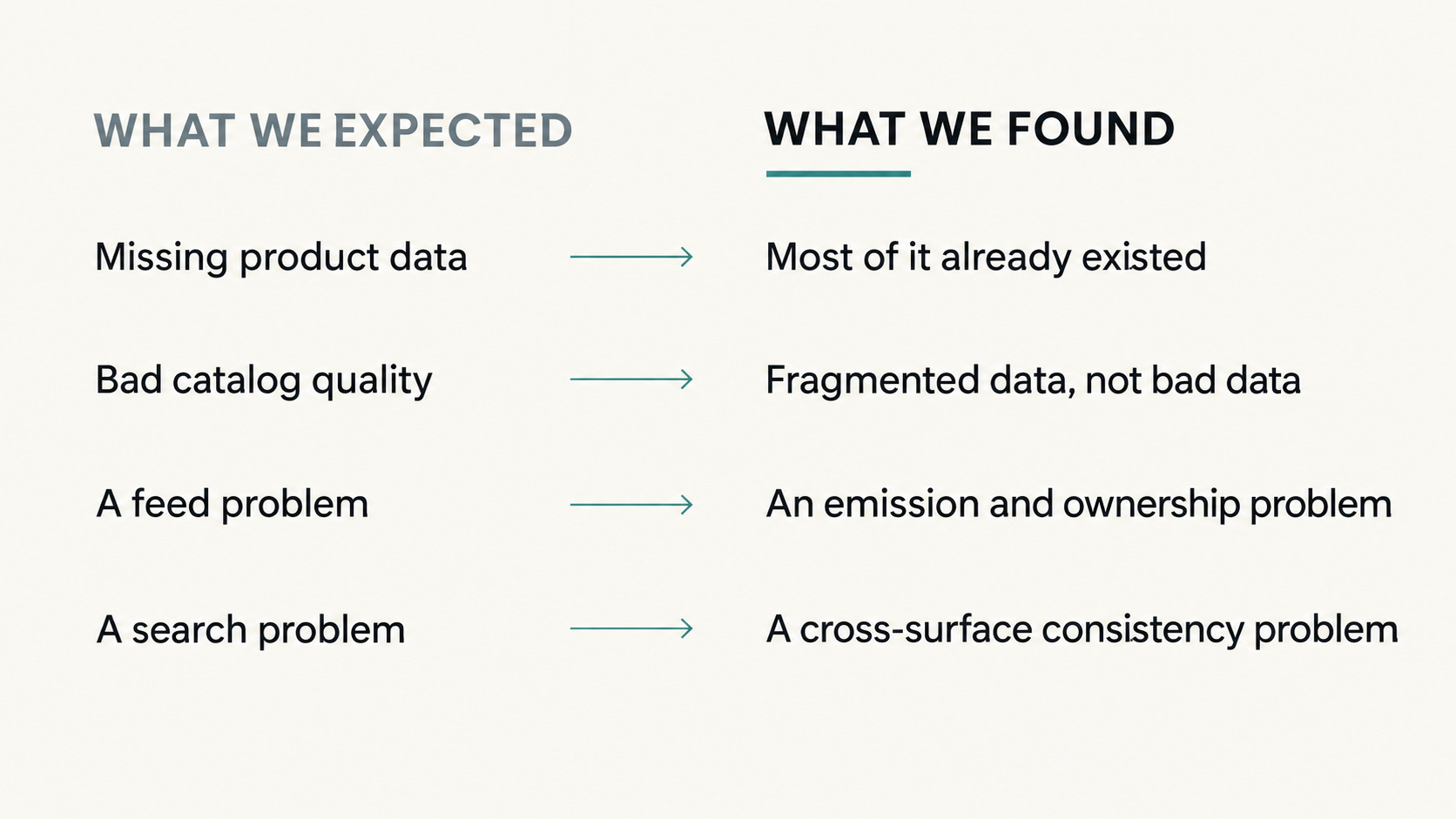
Every finding in this piece traces back to a core truth: the problem isn’t search. It’s that the same product can look different, incomplete, or contradictory depending on which surface is representing it. And nobody is checking whether they all agree.
Shopify is permissive by design. It accepts your products and provides the infrastructure to publish them, but it doesn’t serve as a comprehensive validator of whether your catalog, storefront, feeds, and structured data meet every downstream system’s requirements. That’s a reasonable platform decision, as Shopify can’t know what every downstream system needs. But it means gaps can look fine inside Admin and create real problems outside it.
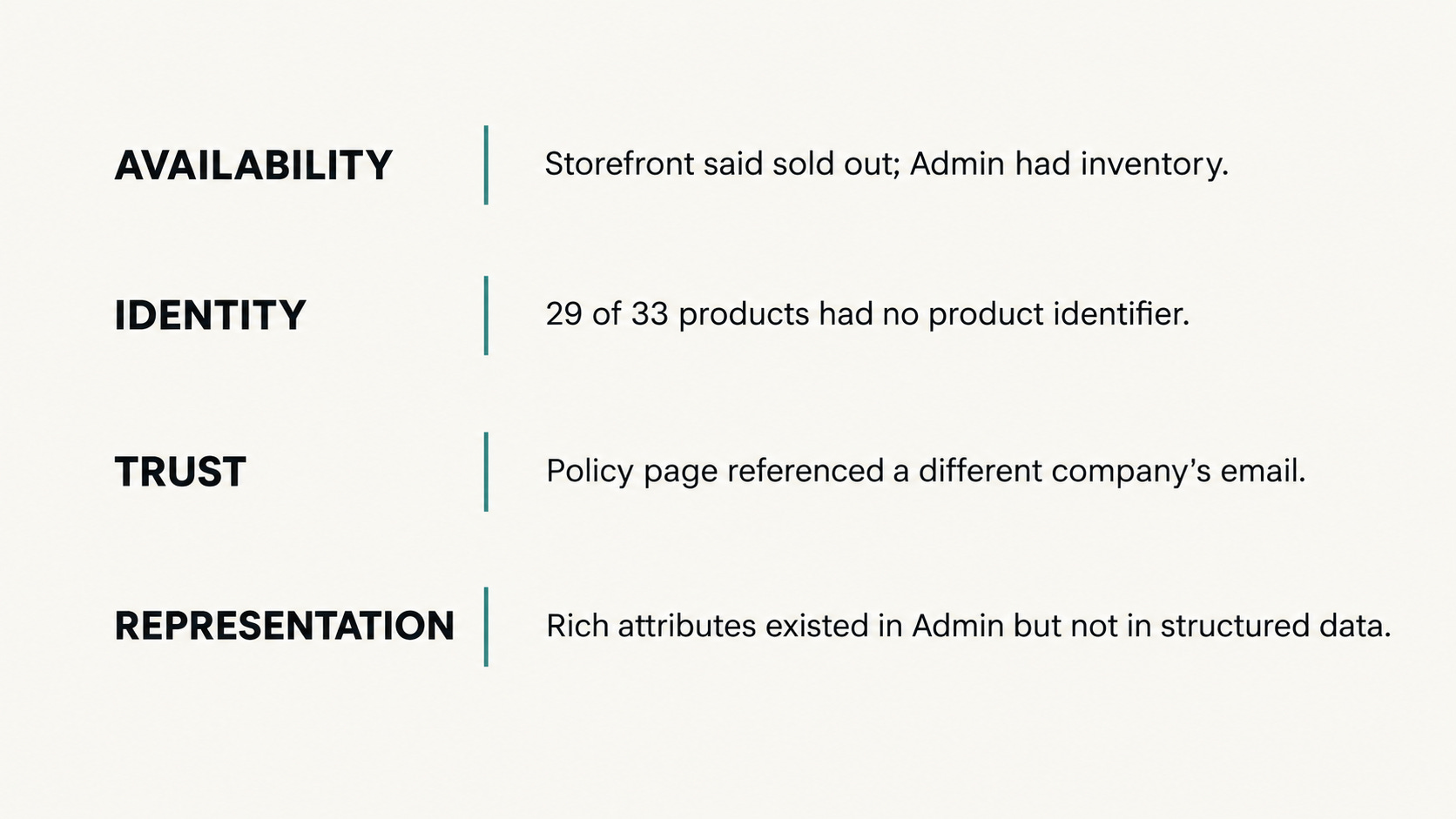
On FYI, we found four classes of these gaps. They aren’t four unrelated Shopify problems. They’re four cases where the information in one part of the commerce system disagreed with, or failed to reach, the representation consumed by another system.
The first was availability. During the initial audit, one of FYI’s core SKUs, the daily moisturiser, displayed “Sold Out” on the storefront despite inventory sitting in Admin. Storefront availability and Admin inventory are separate signals; Shopify doesn’t automatically reconcile them. The mismatch was flagged and has since been corrected. But it illustrates the pattern in its simplest form: Admin had the right inventory. The storefront was telling a different story. Any system relying on the storefront’s availability signal — whether an AI platform, a search crawler, or a feed that pulls from the live page — would treat the product as unavailable, regardless of what the inventory dashboard showed.
The second was identity. Of FYI's 33 active SKUs, only 4, the core aftercare singles, carried a manufacturer-assigned barcode. The remaining 29 products had no product identifiers at all. Shopify accepted every one without flagging it. GTINs give downstream product-discovery systems a standardized identifier they can use to match a product across catalogs and merchants. Without them, the feed couldn't clearly communicate identifier status, leaving 29 products in a state where downstream systems had to infer whether identifiers were legitimately absent or simply missing.
The third was trust. FYI's Privacy Policy contained a contact email, support@dyou.co, from a different cosmetics brand entirely. The rest of the policy correctly referenced care@flauntyourink.com. A template copy-paste artifact that nobody caught. The store contained two different answers to the question "How do I contact this business?" That's not an SEO error. It's a consistency error, the kind that makes an external system's representation of the merchant contradictory.
The fourth was representation. Rich product attributes — cosmetic function, certifications, skin care effects, key ingredients — existed in the Admin metafields and were displayed on the product page visually. But they were absent from the Product JSON-LD that external systems actually read. The basic product identity was consistent across surfaces. The rich attributes weren't represented in the structured data at all.
None of these four problems is uniquely an AI problem. That's precisely the point. AI surfaces expose inconsistencies that already existed in the commerce stack, because they assemble information from multiple representations of the same merchant and product. SEO asks whether a search engine can discover and rank a page. AI visibility asks a different question: what information can an external system actually retrieve, reconcile, and confidently use when representing your product?
Everybody is doing their job. That’s actually the problem.
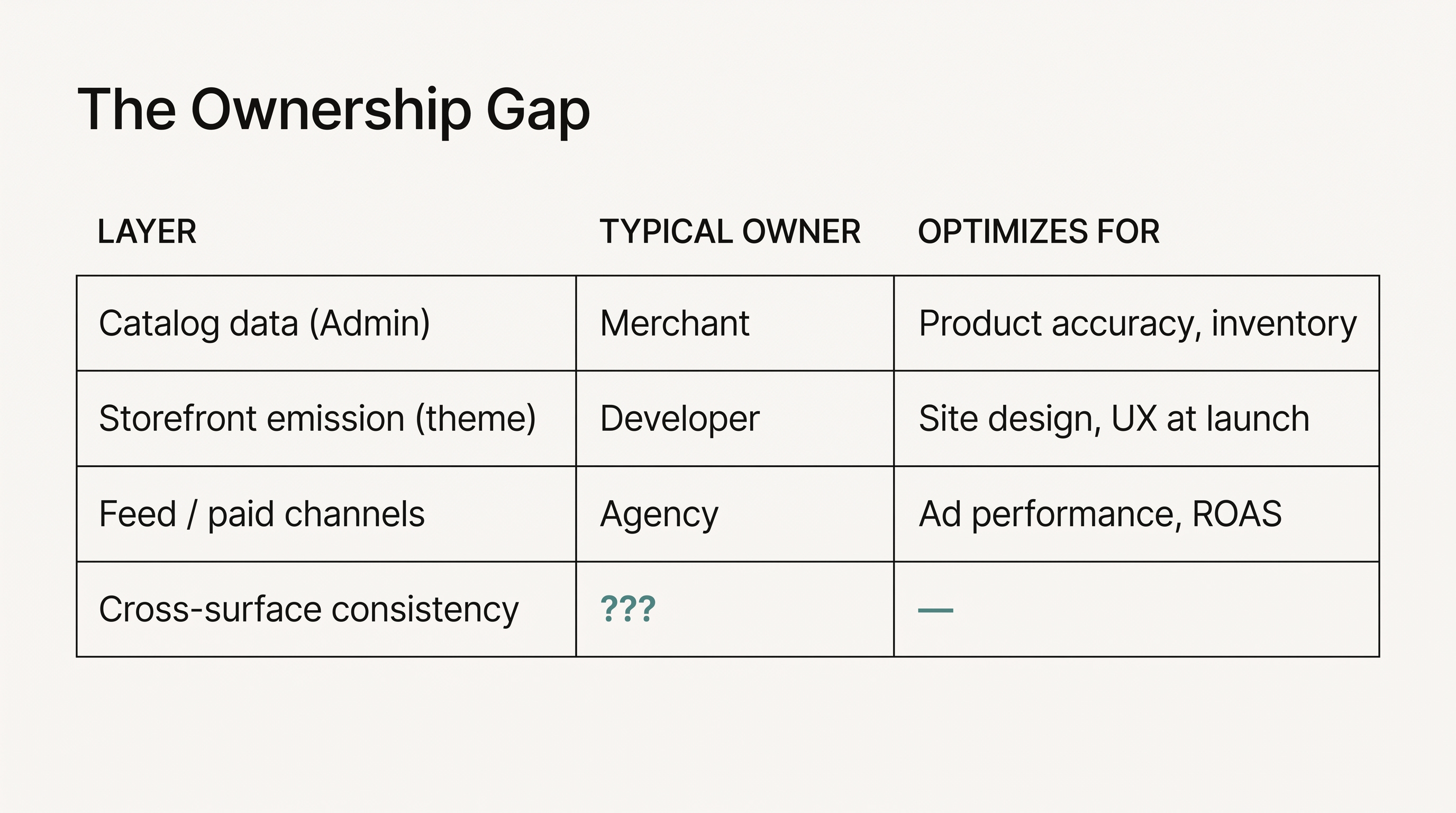
On a typical Shopify store, the merchant manages the Admin: products, inventory, pricing, content pages. The agency manages the paid channels: the GMC feed, Shopping campaigns, maybe Meta ads. The developer built the theme at launch and handles change requests when they come in.
Each of those roles has clear ownership. And between them, there’s a layer that belongs to nobody.
The merchant owns the catalog. The developer owns the storefront. The agency owns the feed. Nobody owns the consistency between them.
Metafields aren’t the merchant’s responsibility; most merchants don’t know metafields exist, let alone which ones are populated or what they’re for. They aren’t the agency’s responsibility, as the agency manages the feed, not the store’s data architecture. They aren’t the developer’s responsibility; the developer builds what’s scoped, and nobody scoped metafield governance.
On FYI, an entire product line, the flaunt MEN grooming range of 14 SKUs, sat with empty category codes, empty SEO metafields, and empty feed attributes for weeks. The products weren’t ready because the line was still being finalized, and enrichment work had been deferred until the range was confirmed. The empty metafield slots existed, waiting for someone to populate them. Nobody did. The grooming line was structurally incomplete on external surfaces during that entire period.
Once the range was confirmed, we populated 105 missing product-data fields in a single session: category information, SEO fields, product classifications, and FAQ data. Work that had been deferred for weeks took hours. The bottleneck wasn’t capability. It was that the decision to proceed hadn’t been connected to the catalog layer that needed to reflect it.
A business decision existed. The catalog didn’t know about it. That’s the ownership gap in miniature.
The same pattern becomes harder — not easier — as organizations get larger: business decisions can exist in someone’s head or email thread without reaching the catalog layer that needs to act on them.
JSON-LD emission was configured when the theme was built. Nobody re-scoped it when AI surfaces emerged as a distribution channel. The developer delivered what was asked for. Nobody asked for structured data that didn’t exist as a requirement at the time.
Policy pages were written once at launch. Nobody revisits them. Nobody checks whether they’re consistent with what the feeds are sending.
The finding wasn’t that anyone was failing. It was that everyone was succeeding at their piece while the system-level consistency — the question of whether the same product looks the same across every surface — had no owner at all.
The feed is the agency’s problem. The store is the merchant’s problem. The metafields are nobody’s problem. That’s the gap.
Then we found the same problem in our own audit. Our query returned only the first 50 metafields per product. Five core products had more than 60 populated fields, so our diagnostic incorrectly reported missing data. The catalog wasn’t missing the information. Our diagnostic simply wasn’t reading far enough. If nobody owns the diagnostic itself, even your audit can create false gaps.
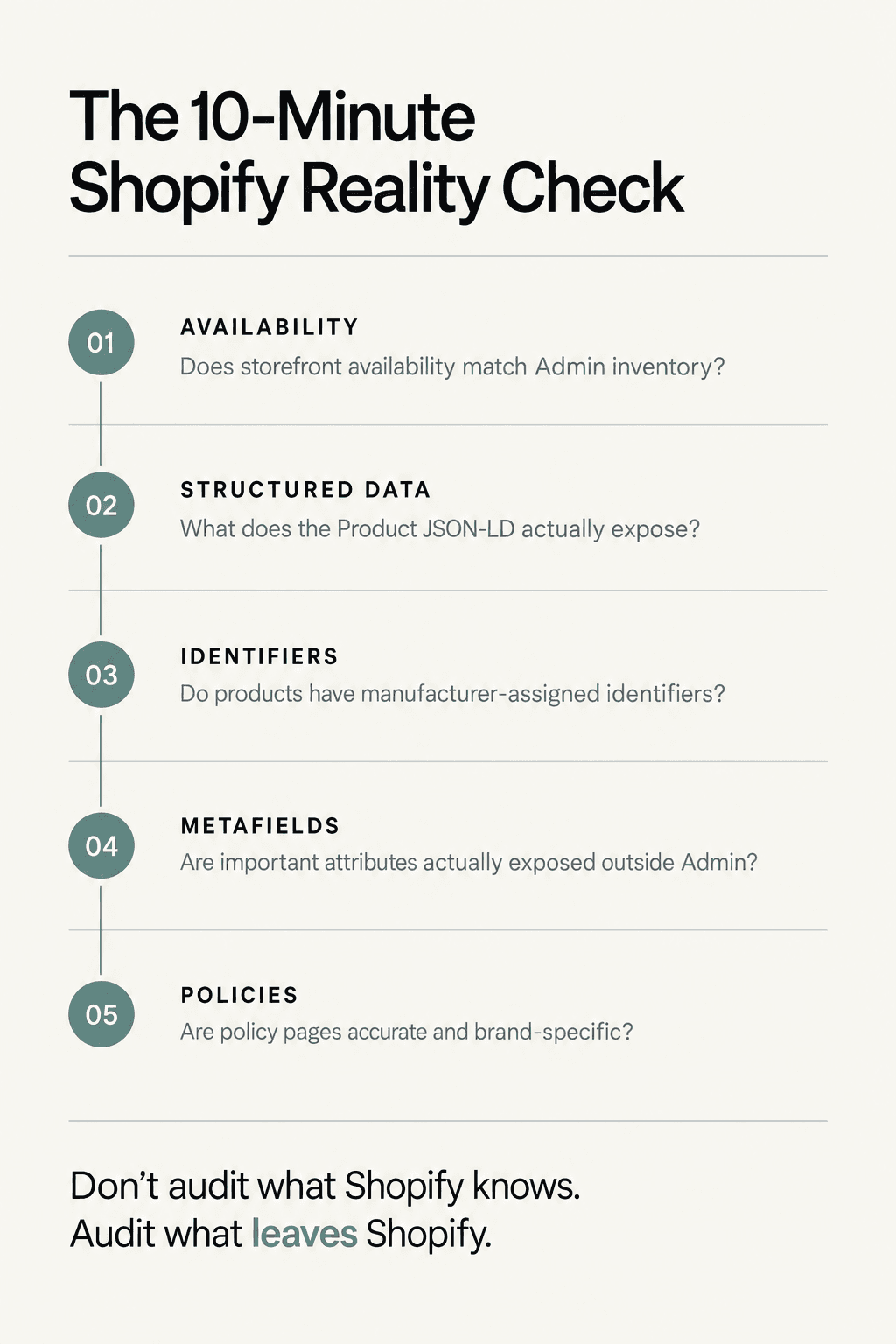
This isn’t a remediation plan. It’s a diagnostic. Five things you can check in roughly ten minutes that will tell you whether your Shopify store has the kinds of gaps we found on FYI — or whether you’re in better shape than you thought.
Check storefront availability against Admin inventory. Open your best-selling product on the live storefront. Does it say “Add to Cart” or “Sold Out”? Now open the same product in Shopify Admin. What does inventory show? If those two disagree, every external system reading your storefront is getting the wrong availability signal. Start with your top five SKUs.
Inspect your Product structured data. Go to Google’s Rich Results Test and paste one of your product page URLs. Look at the Product markup it detects. Do you see price, availability, brand, SKU, review data? Or just a title and image? The difference is what your theme is actually emitting as structured data. Test three product pages from different product lines — themes sometimes handle product types inconsistently.
Check your identifiers. Open any product in Shopify Admin and look at the barcode / GTIN field. Is it populated? Do this for five products across your catalog. If they’re all blank, determine whether those products legitimately lack GTINs or whether identifier data is simply missing. Either way, the feed needs to communicate identifier status clearly rather than leaving downstream systems to guess.
Inspect your metafields. Open a product in Shopify Admin, scroll past the standard fields, and look at the metafields section. How many are populated? Can you explain what each one does? Do you recognize the namespace names, or are they artifacts of apps you installed months ago? If you can’t narrate what’s there and why, nobody else on your team can either — and that means the richest layer of your product data has no owner.
Check your policies. Open your Shipping, Refund, and Privacy policies. Are they current, internally consistent, and clearly associated with your business? Check names, emails, addresses, and return terms. These pages provide information external systems use to evaluate your store. If they’re referencing another store or contradicting each other, the information they provide is working against you.
Shopify wasn’t the bottleneck. Nobody was.
Everybody owned a piece. Nobody owned the system.
In most of what we measured, Shopify’s infrastructure was ahead of what the merchant had actually configured, ahead of what the theme was actually emitting, and ahead of what the agency was actually optimizing for.
The bottleneck is the unowned layer between your Shopify catalog and the external surfaces representing your products. The metafields nobody governs. The JSON-LD nobody re-scoped. The feed nobody reads from the AI surface’s perspective. The policies nobody revisited. The 14 SKUs that sat structurally incomplete because a product decision hadn’t reached the data layer.
We closed part of that gap on FYI — 105 product-data fields, populated once the range was confirmed. Some gaps remain — product images for the grooming line, taxonomy assignments that are blocked on inputs we don’t yet have. The work is ongoing precisely because the layer it targets didn’t exist as anyone’s responsibility before we created it.
The question worth asking isn’t “Is my Shopify store AI-ready?” That frames it as a platform problem, and it isn’t one. The better question is: what does each external system actually receive when it looks at my product — and does that match what I know about my own catalog?
Don’t audit your Shopify store. Audit what leaves it.
This is Part 3 of The New Shelf’s Shopify Playbook — a three-part practitioner assessment of what Shopify gives you for AI visibility and where it falls short.
Part 1 covers why most Shopify stores have more product data than AI can see.
Part 2 covers the feed layer — four types of failure hiding behind one symptom.
How does AI search see your store right now?
We run real category queries across ChatGPT, Perplexity, and Google AI Mode, inspect your catalog representations, and send you a plain-language report. Completely organic; we never ask for logins or ad spend.
Request your report
Two fields. A person reviews it and emails you back within 48 hours.