The Evidence Layer: What Made Those Products Discoverable
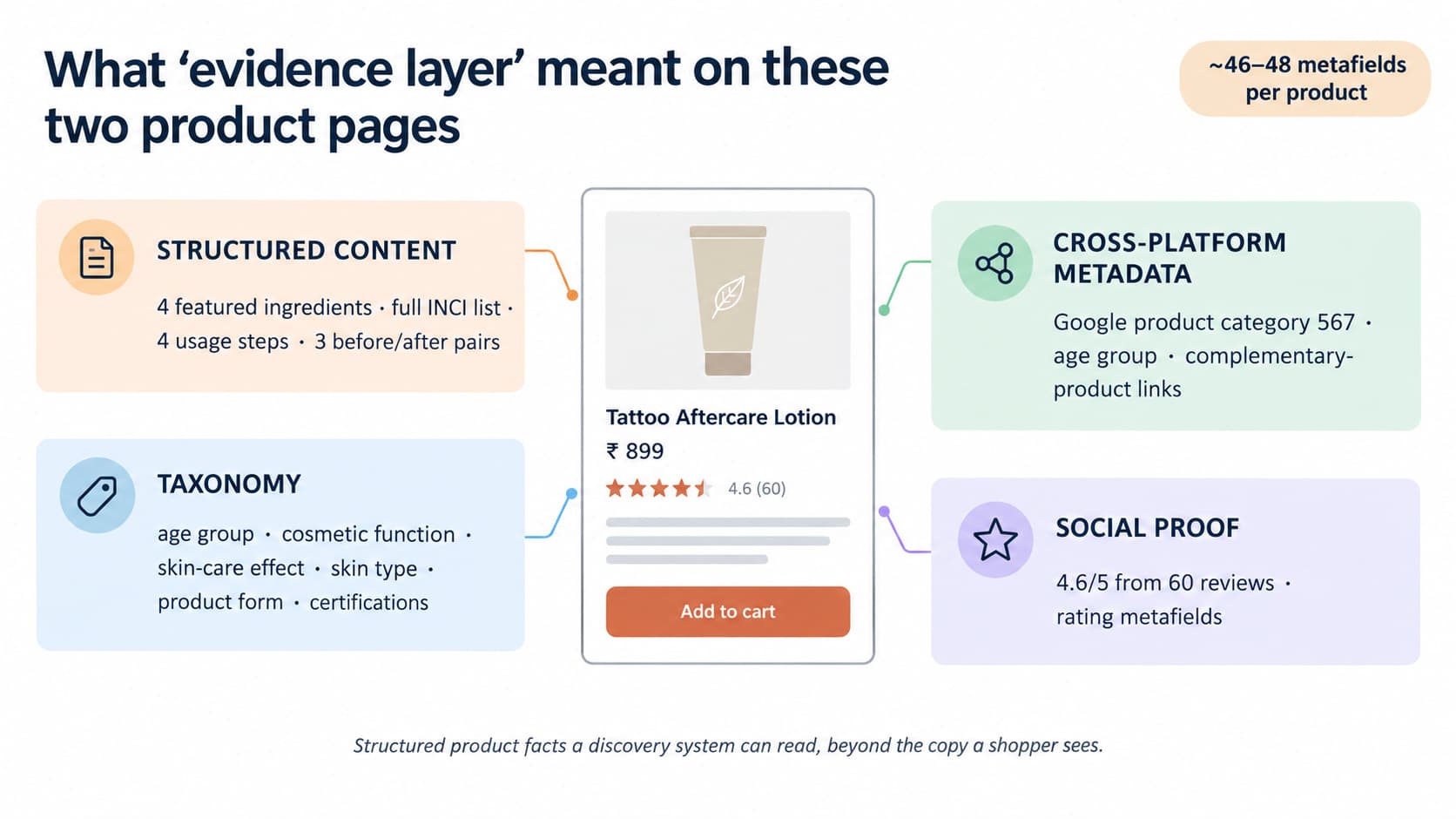
This piece opens the hood: what was in those product records, how they compare with products that haven't had the same work, and where a merchant should start.
By evidence layer, we mean the structured product facts a discovery system can access: ingredients, usage instructions, classifications, reviews, and relationships to other products.
This is the second half of a two-part piece in The New Shelf series. Part 1 — "When ChatGPT Became a Front Door to a Shopify Store" — has the four converting journeys. You can read this piece on its own, but the journeys give it context.
Quick Recap
Part 1 established three findings:
ChatGPT referred 70 organic sessions to Flaunt Your Ink, a tattoo aftercare brand on Shopify, between July 1 and September 21, 2026. Four of those sessions converted into five Shopify orders totaling ₹3,127 (one buyer checked out twice, so four sessions produced five orders). No feed was submitted and no ads were bought. India is geo-gated from both programs, so every referral was organic.
The four converting sessions came through three surface types: two product pages, one collection page, and one homepage. All three types converted.
The two products behind the direct product-page conversions also perform among the store’s best in Google Search and Google Merchant Center (GMC). That cross-surface consistency suggests the product’s evidence layer may be a more useful unit of optimization than any single channel.
The Enriched vs. the Unenriched
Part 1 showed that the two products with direct PDP conversions from ChatGPT have the highest click potential in Google Merchant Center and ~500K GMC impressions each. Here’s what the comparison looks like alongside products that haven’t been through the same enrichment process.
Google Merchant Center · Jul 1 – Sep 21
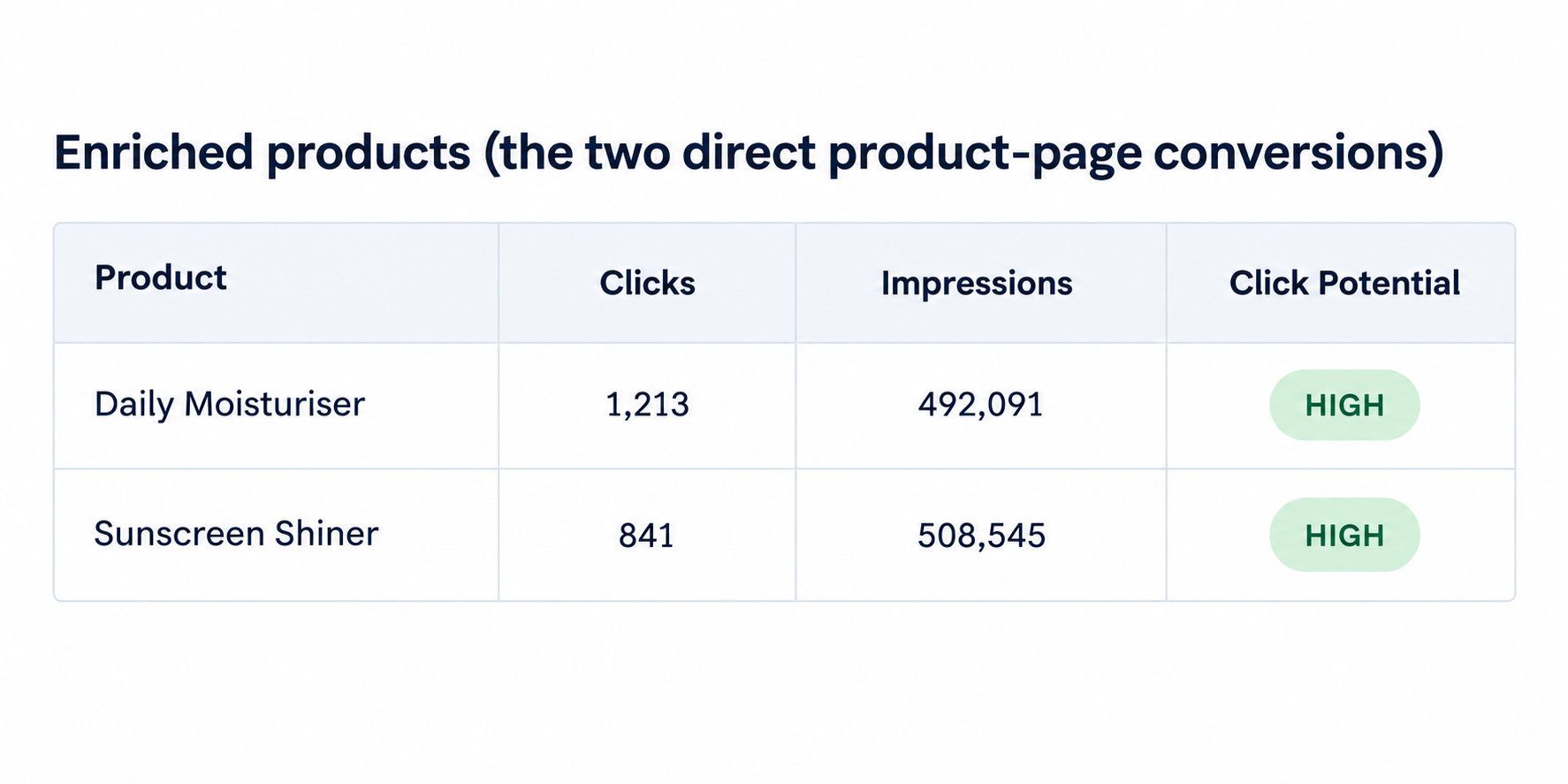
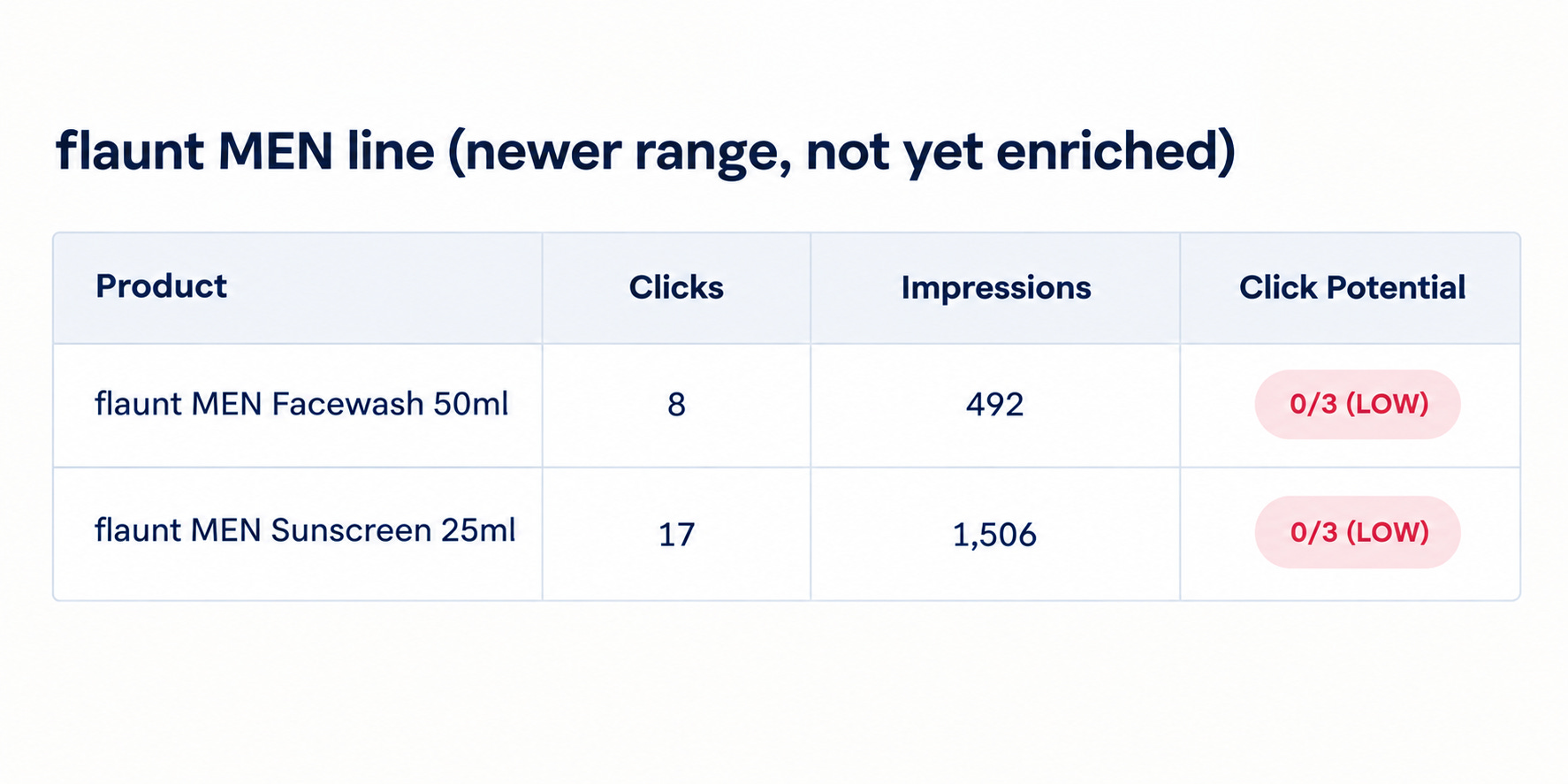
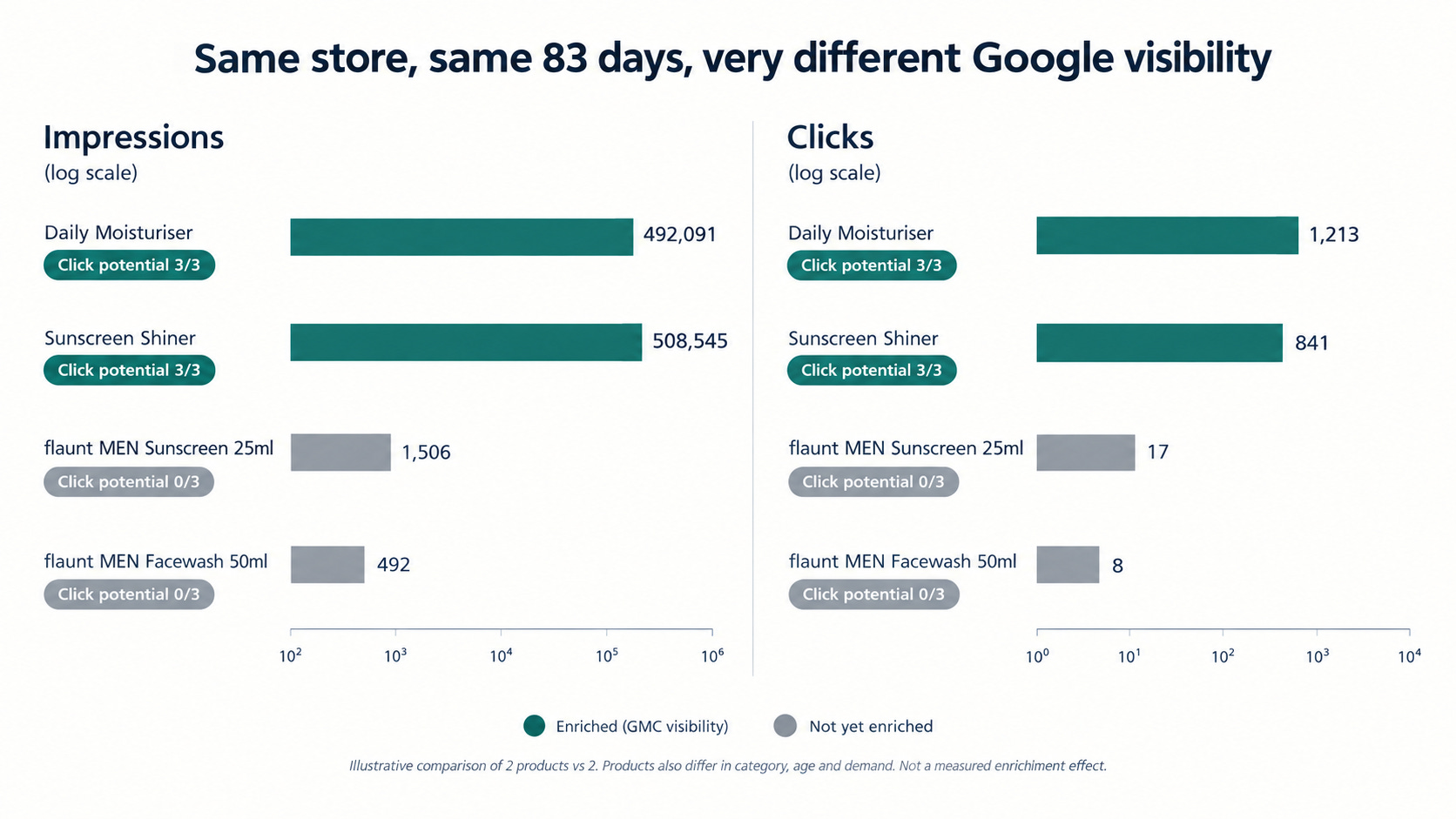
The enriched products have roughly 300–1,000× the impressions and 50–150× the clicks of the unenriched ones.
Read this as a small, illustrative comparison: two products against two, not a measured enrichment effect. The products differ in more than enrichment: category, how long they've been in the catalog, and demand. The gap can't be attributed to enrichment alone. What we can say is that it points the way the enrichment hypothesis predicts: products with richer structured data tend to surface more broadly.
What Changed in the Catalog
The two products that generated direct product-page conversions are among the most deeply enriched in the catalog. Enrichment meant adding structured product information to Shopify metafields, the fields where Shopify stores structured product facts that themes, feeds and apps can read.
Enrichment began with maintenance-level catalog changes in late July. Core product-page enrichment was substantially complete by August 21. The first converting ChatGPT session came on August 25.
What enrichment looked like
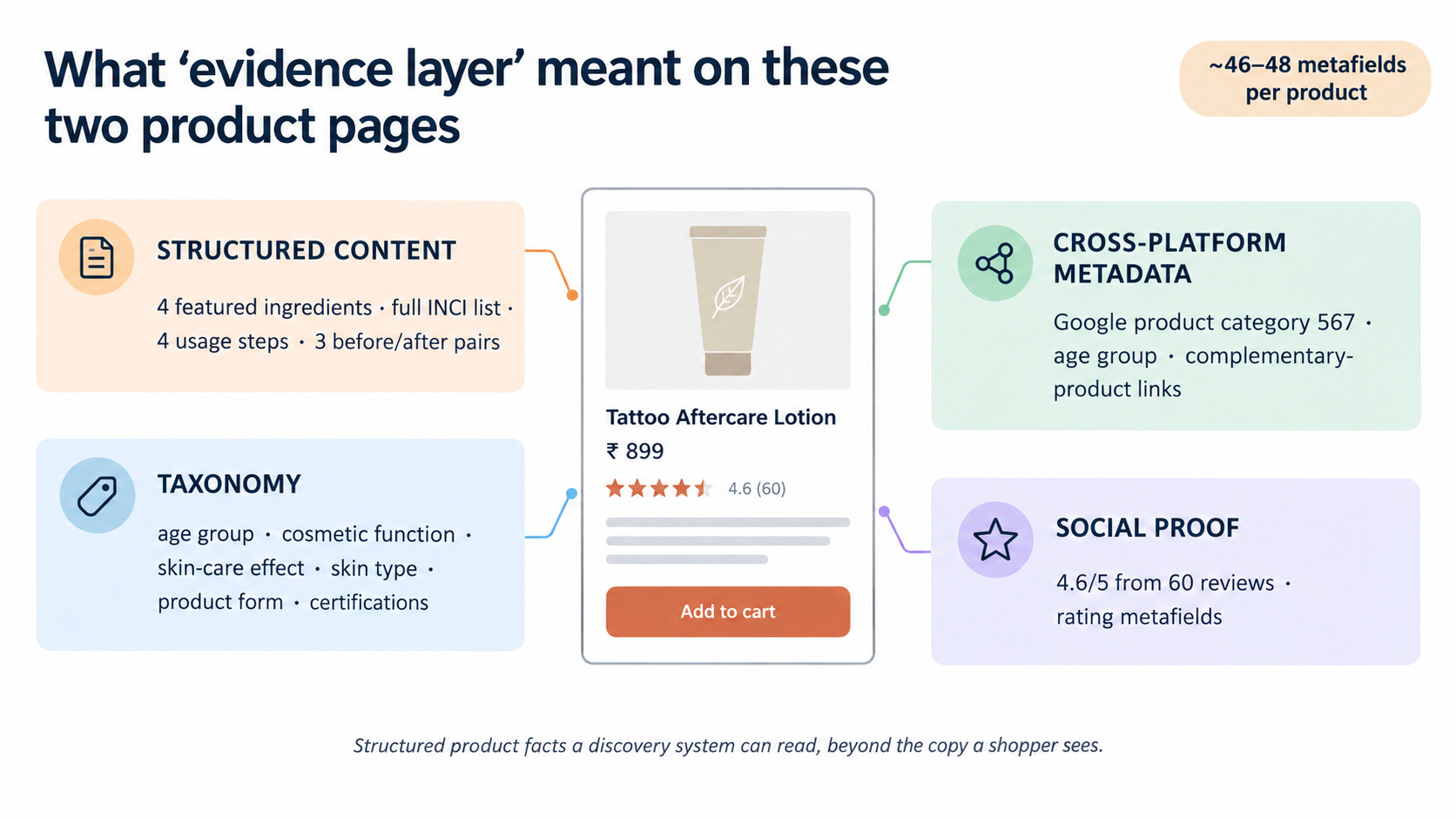
Each product received roughly 46–48 metafield entries, in four layers:
Structured content. Short descriptions written to be machine-readable. Four featured ingredients, each with a title, image and benefit description. Full INCI (International Nomenclature of Cosmetic Ingredients) lists. Four-step usage instructions. Three before/after image pairs. Routine images showing the product in a care sequence.
Taxonomy. Shopify product-taxonomy classification: age group, cosmetic function, skin-care effect, suitable skin type, product form, certifications. The Moisturiser carries 9 certification references and 7 skin-care-effect references. The Sunscreen carries 10 certification references, 2 skin-care-effect references and 6 skin-care-feature references. (The two products use different taxonomy attributes because they are different product types.)
Cross-platform metadata. Google product category mapping (category 567, Skin Care). Age-group classification. Complementary-product cross-links connecting each product to related SKUs.
Social proof. Review aggregation (the Moisturiser has 4.6/5 from 60 reviews via Judge.me) and rating metafields so the ratings can be emitted as structured data.
The timeline
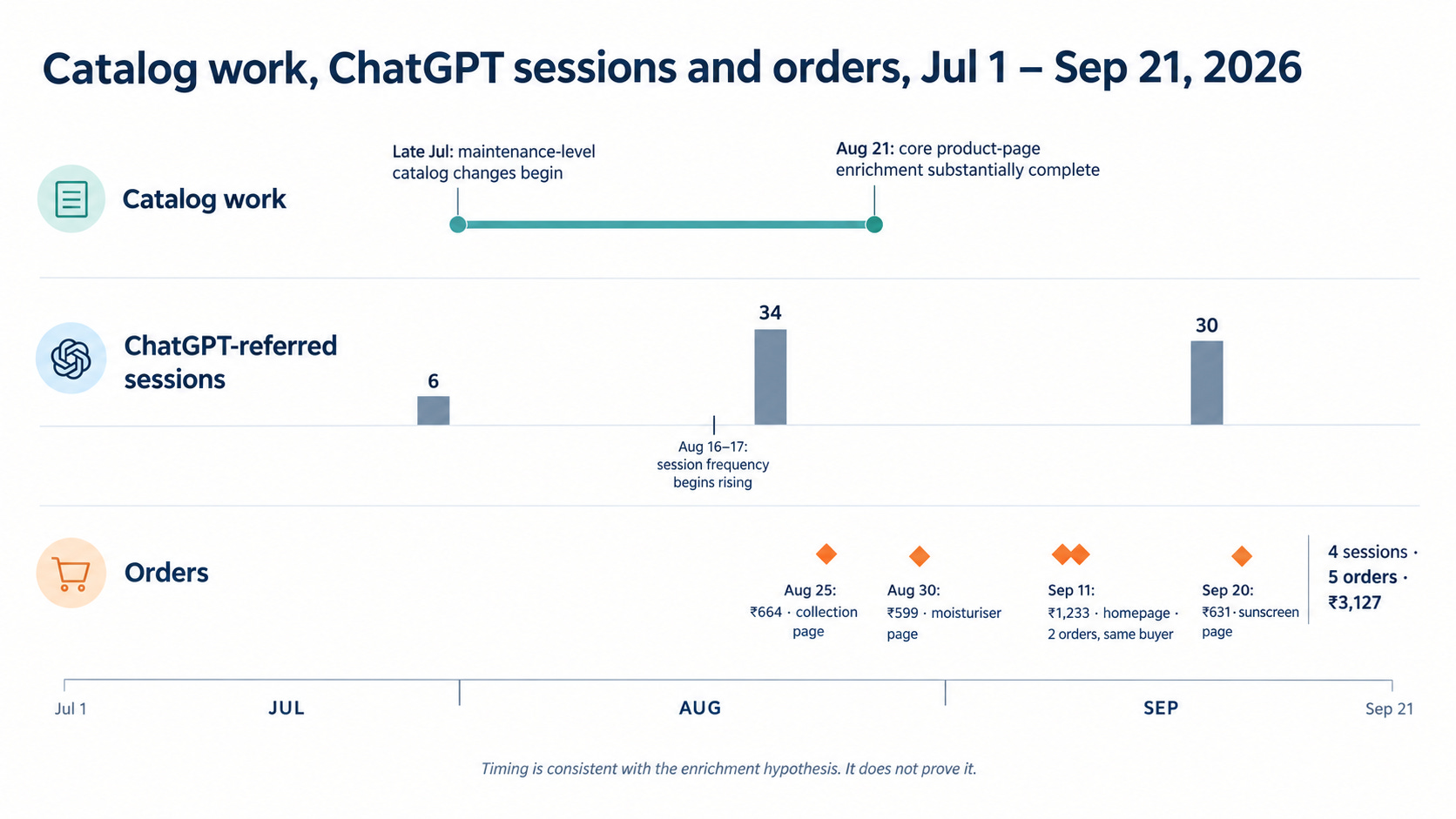
The timing is consistent with the hypothesis that richer product information improved discoverability. But this dataset cannot isolate enrichment as the cause. Seasonal demand, ChatGPT's expanding product knowledge and general traffic patterns could all contribute. We note the correlation and the mechanism. We do not claim causation.
What We Cannot Claim
We cannot see the original ChatGPT prompt. We observe the destination and infer the question. GA4 records where someone landed, not what they asked or what ChatGPT showed them.
We cannot establish causation between enrichment and ChatGPT conversions. The timeline is consistent and the mechanism is plausible, but this is an observational study with four converting sessions. Multiple variables changed at once.
Our 70-session count is a floor, not a census. GA4 relies on the HTTP referrer header to attribute sessions to ChatGPT. When a user copies a URL from a ChatGPT conversation and pastes it into a browser, or the link opens somewhere that strips referrer data, the session shows up as Direct traffic. The true AI-referred count is likely higher, but we can’t measure the gap.
The sample means traceability, not statistics. Four converting sessions and ₹3,127 in revenue is a signal. Its value is in the end-to-end path (AI referral, landing page, verified purchase), not the volume.
The cross-domain checkout introduces attribution risk. The store uses Shopflo for checkout, which creates a cross-domain redirect. GA4’s attribution chain can break at that handoff, so some purchases may not be attributed back to the original ChatGPT session.
Click potential is Google’s assessment, not ours. GMC’s click-potential rating is Google’s internal catalog-quality signal. We report it as a data point, not as an explanation of how AI systems choose products.
What We’d Do Differently After Seeing This
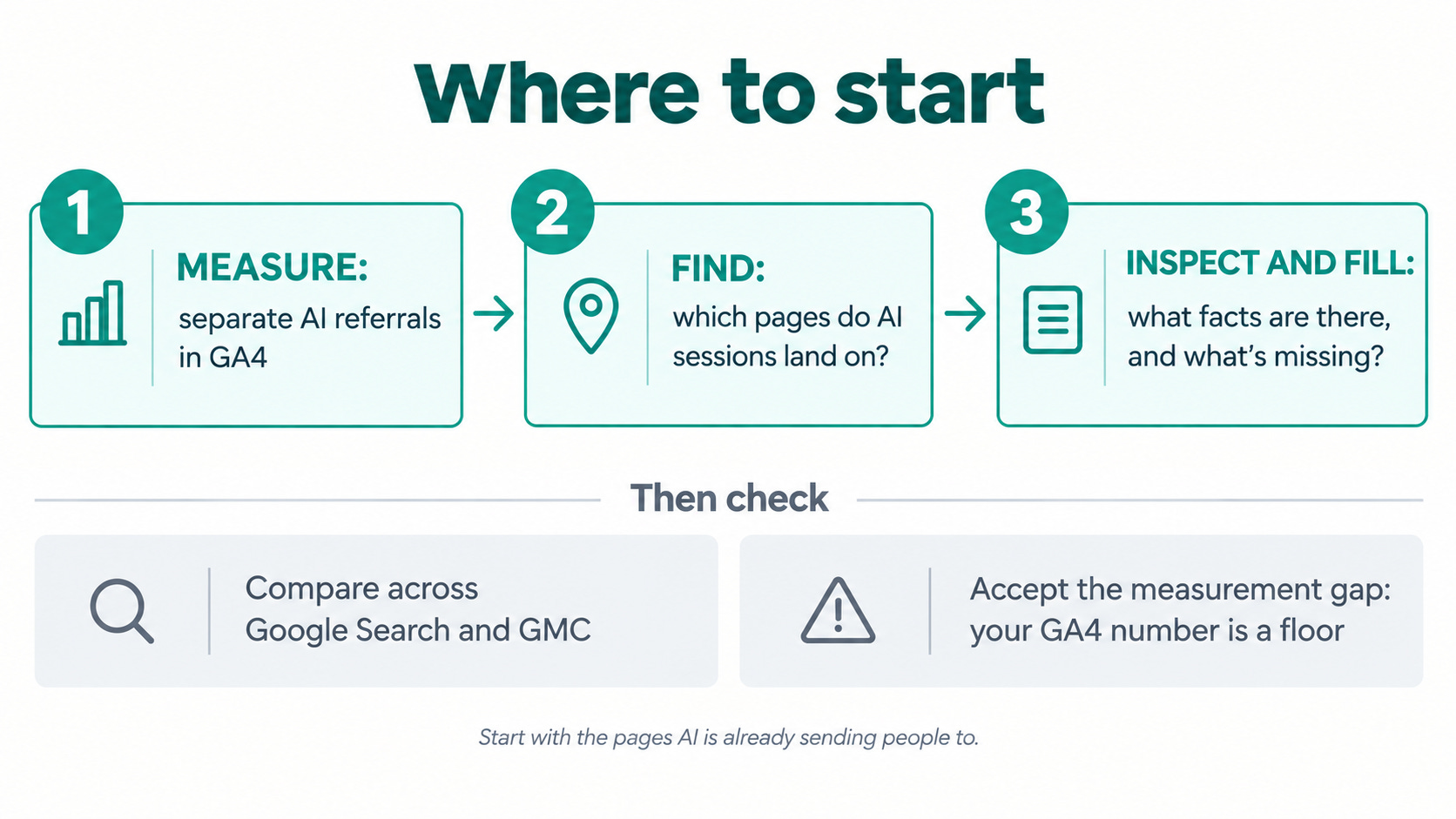
These steps come from what we observed. If you only do three things, do them in this order: measure AI referrals separately (step 1), find which pages they land on (step 2), then inspect the evidence on those pages and fill the specific gaps (step 4). Steps 3 and 5 are checks you run once those are in place. None of this guarantees AI visibility. It tells you where to look first.
1. Measure AI referrals separately
Set up a custom GA4 channel grouping for AI referral sources. GA4 doesn’t have a default channel group for AI assistants, so without one this traffic gets absorbed into default buckets where it can’t be isolated. It takes about five minutes:
GA4 → Admin → Channel Groups
Create a new custom channel group
Add a rule: Source matches chatgpt.com
Name it (we used “AI Assistant”)
2. Find the landing pages
AI referrals arrive at specific URLs. Those URLs are the observable evidence of what the AI system treated as relevant. Track which pages receive AI traffic and whether those sessions engage, browse or purchase.
3. Compare those products across Search and GMC
Check whether the products that receive ChatGPT referrals also perform well in GMC and Google Search. The same product looking strong across several systems is a sign that its evidence layer is working, not just one channel. Treat it as a consistency check, not proof of how ChatGPT chooses.
4. Inspect the evidence available on those pages, then fill the gaps
The converting pages belong to some of the most information-rich products in the catalog. They carry structured ingredient information, usage instructions, taxonomy classifications and links to related products. That is consistent with our enrichment hypothesis, although the dataset does not establish that these attributes caused the conversions.
For any page already receiving AI referrals, list the facts a shopper would ask about (what’s in it, how to use it, who it’s for, how it differs from the alternative) and check that each exists as a structured fact, not just as copy. Where one is missing, that is your first piece of enrichment work.
5. Track the gaps you still can’t observe
Accept the measurement gap. You won’t see every AI-referred session, because referrer stripping and cross-domain checkout both reduce what GA4 can attribute. The number you see is a floor. Design your measurement around that rather than waiting for perfect attribution.
What’s Next
This piece tracked organic ChatGPT referrals: sessions where the AI model found the catalog through its own processes, with no submitted feed or purchased placement. A separate piece will look at what changes when merchants can submit products to AI discovery systems directly, and how that shifts measurement, attribution, and the line between organic and paid AI commerce.
One question for you: if an AI assistant sent a shopper to your store today, which page would it land on, and what would that page tell the model about the product?
Series Links
When ChatGPT Became a Front Door to a Shopify Store — Part 1 of this piece: the four converting journeys.
Google: Seven Surfaces, One Feed — The cross-surface framework behind this piece’s Google data.
Your Shopify Store Has More Product Data Than AI Can See — Why structured product data often never reaches the systems that need it.
We Had 33 Products in Shopify. Only 17 Were Showing Up. — Feed-side enrichment on the same store.
Nobody Owns the Layer Between Your Shopify Store and AI — Who is responsible for fixing the gaps.
Methodology note: All data was collected from the store’s own GA4 (property 470802980), Google Search Console, Google Merchant Center (account 5540836126), and Shopify admin between July 1 and September 21, 2026 — a window of 83 days. Flaunt Your Ink is named with the brand’s permission. The store is located in India, which is currently geo-gated from ChatGPT’s feed submission and shopping ad programs, meaning all AI referrals in this dataset are organic. Session counts reflect GA4’s settled data as of September 22.
How does AI search see your store right now?
We run real category queries across ChatGPT, Perplexity, and Google AI Mode, inspect your catalog representations, and send you a plain-language report. Completely organic; we never ask for logins or ad spend.
Request your report
Two fields. A person reviews it and emails you back within 48 hours.