When ChatGPT Became a Front Door to a Shopify Store
Good ideas travel faster when you share them; forward this to someone who’d find it useful.
TL;DR
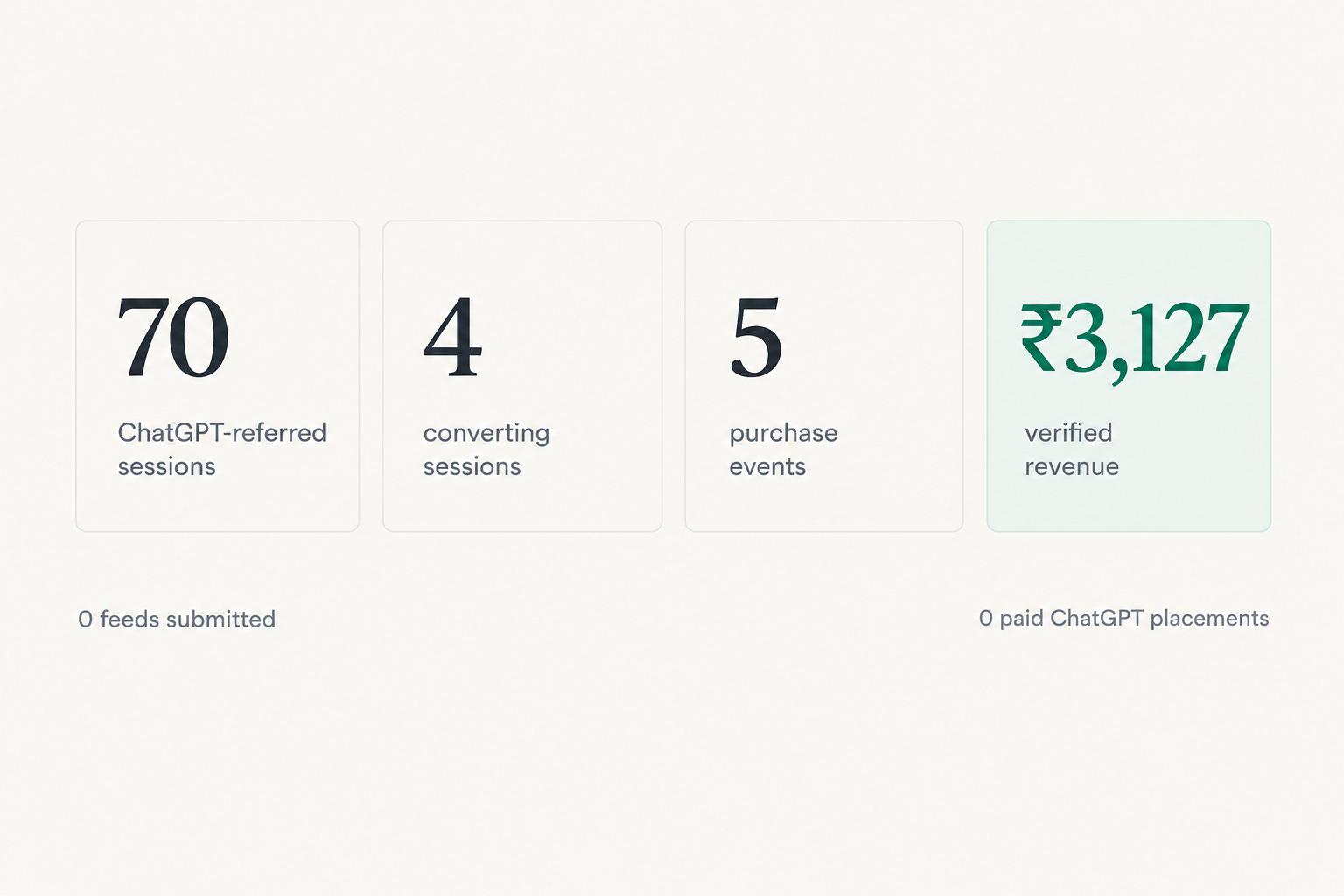
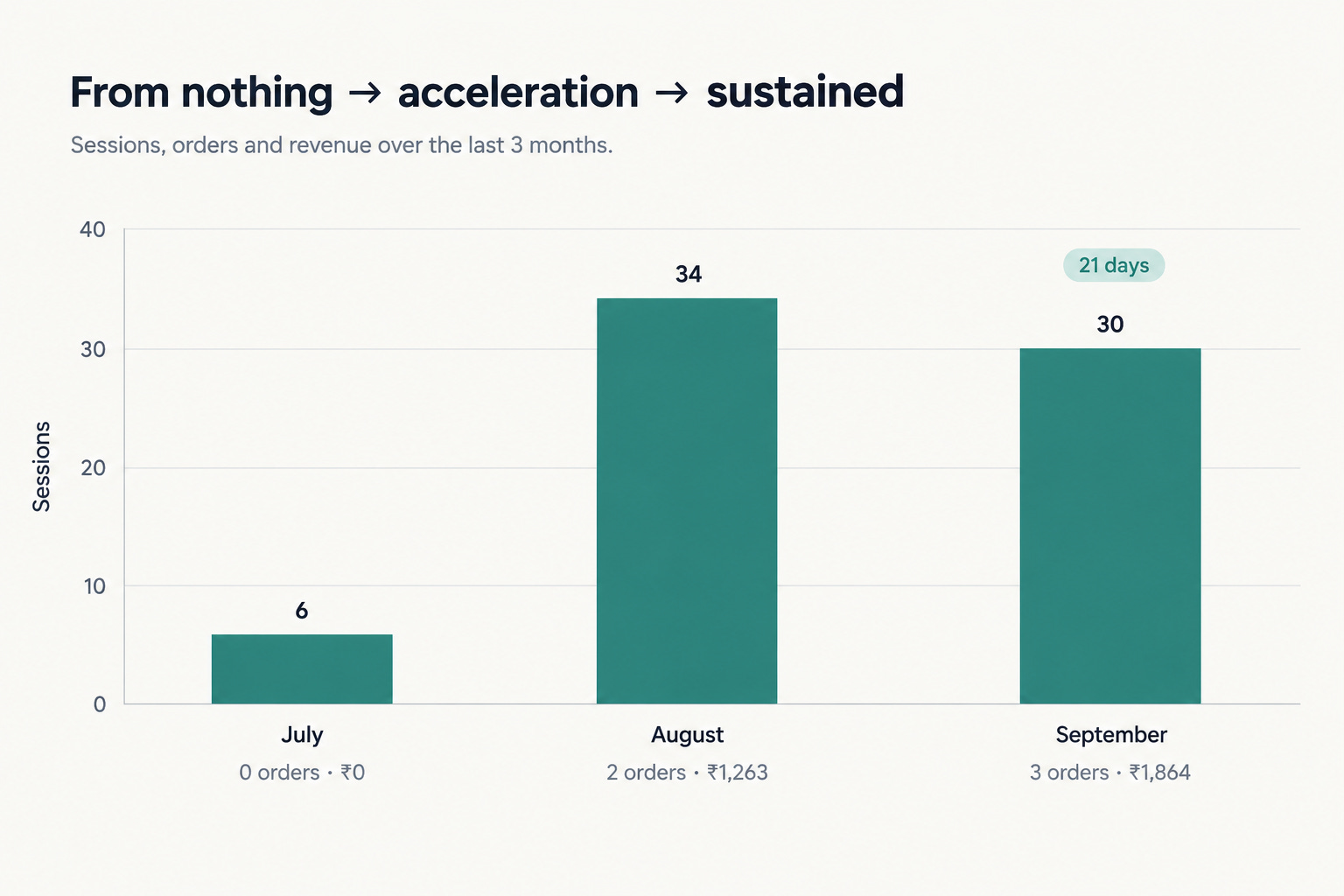
70 sessions arrived from ChatGPT between July 1 and September 21, 2026. Four converted (5.7%, versus 2.4% site-wide) into five purchase events across those four sessions, totaling ₹3,127. With only four conversions, that is directional, not statistically distinguishable from the store average. One session produced two separate orders.
No product feed was submitted. No ads were purchased. India is geo-gated from ChatGPT’s feed and ad programs. Every referral was organic.
The converting sessions landed on three different surface types — a product page, a collection page, and the homepage — and all three converted.
The products that converted from ChatGPT are also among the store’s strongest performers across Google Search and Google Merchant Center. The same catalog enrichment appears to surface across multiple discovery systems simultaneously.
This is a signal, not a sample. Four converting sessions means traceability, not statistical significance.
The New Shelf is our series on how AI systems discover, evaluate, and recommend products. Previous installments examined catalog structure, cross-surface discoverability, and what makes product content machine-readable. This piece follows what happens when someone actually clicks through.
What We Measured
Between July 1 and September 21, 2026, we tracked sessions arriving at Flaunt Your Ink — a tattoo aftercare brand on Shopify — from
chatgpt.comas the recorded session source in Google Analytics 4 (GA4).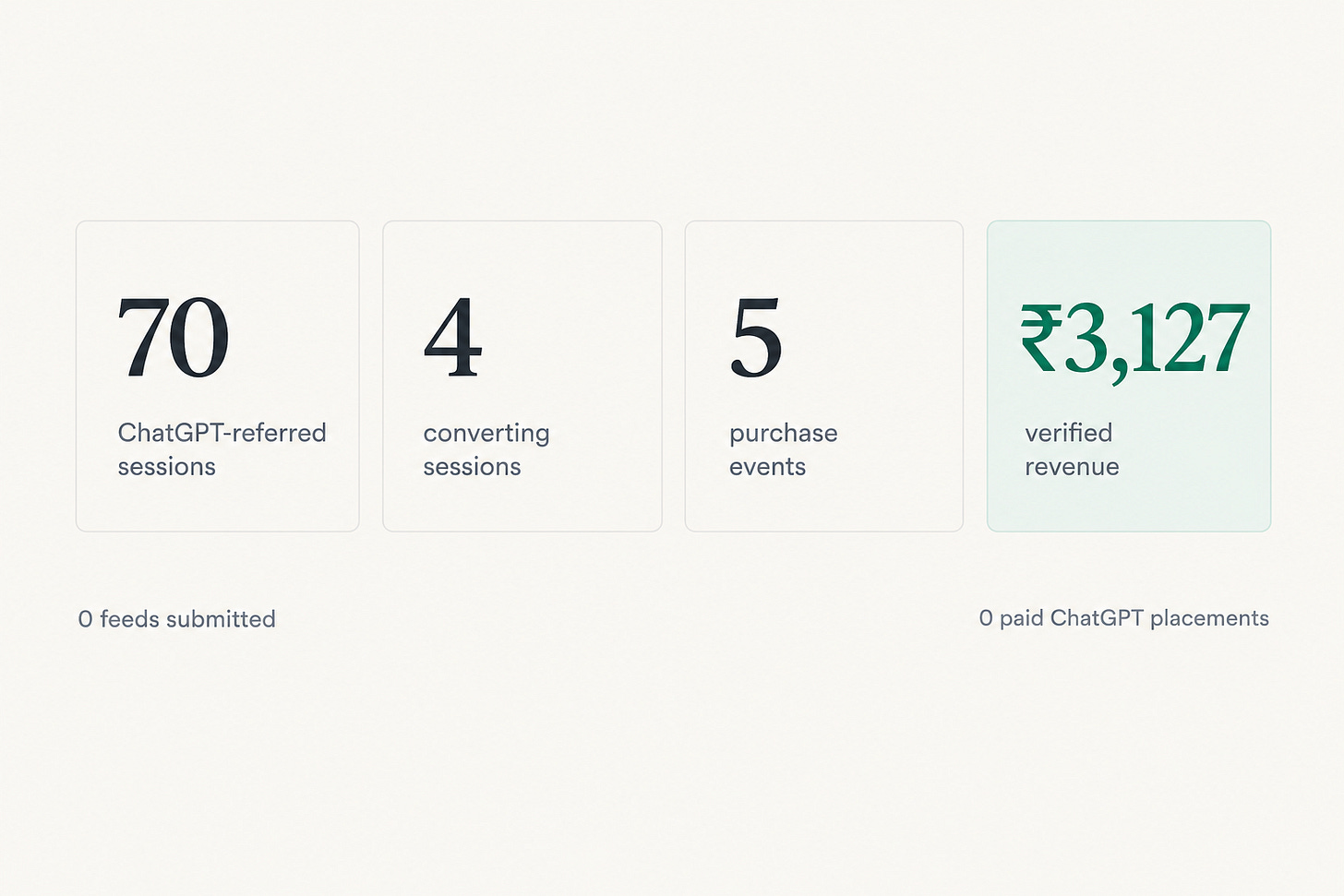
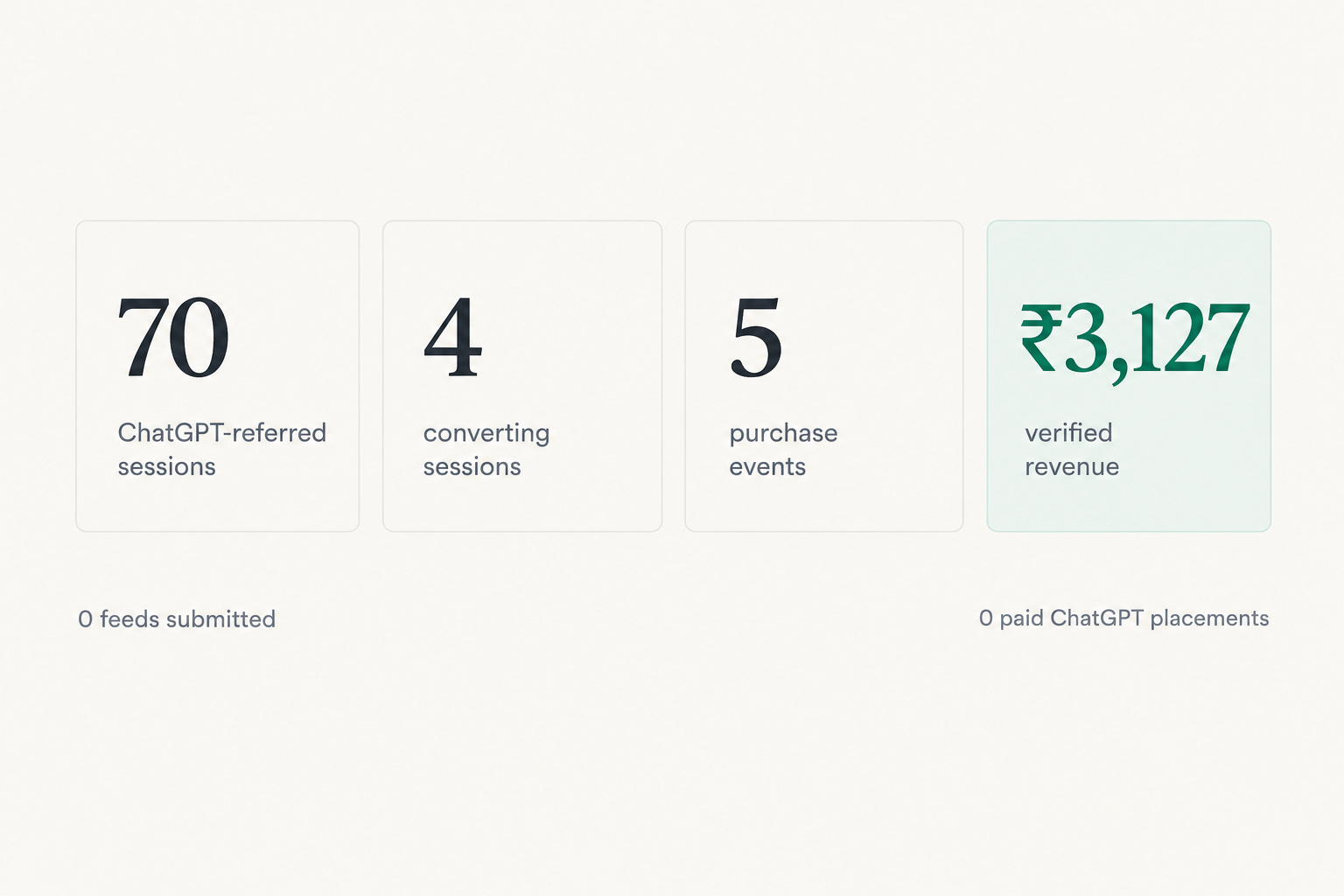
For context: the store recorded 89,497 total sessions in the same window, with 2,123 purchases and a purchase rate of 2.4%. ChatGPT accounts for less than 0.1% of traffic. 4 of 70 ChatGPT-referred sessions converted (5.7%), versus 2.4% site-wide. With only four conversions, this is directional, not statistically distinguishable from the store average.
India is currently geo-gated from ChatGPT’s feed submission and shopping ad programs. Everything in this dataset is organic discovery — ChatGPT referring visitors without a submitted feed or paid placement.
How we captured this. GA4 does not have a default channel group for AI referrals. We created a custom channel grouping called “AI Assistant” to isolate any session where chatgpt.com appears as the source. Without this, ChatGPT traffic gets absorbed into default channel buckets where it can’t be isolated or analyzed.
The interesting question isn't whether ChatGPT can send traffic. It's whether the same product evidence that makes a catalog legible to Google also makes it legible to AI systems. The four journeys below are where that question starts.
One important limitation before the journeys. GA4 tells us that a visitor came from ChatGPT and where they landed. It does not tell us what they asked or what ChatGPT showed them. Everything below is built on observable session data — landing pages, revenue, timestamps — not on the AI conversation itself. We matched GA4 sessions to Shopify orders by date, landing page, and revenue amount.
The Four Journeys
These four converting sessions are the core of the dataset. Each one traces a verifiable path from ChatGPT referral to landing page to purchase.
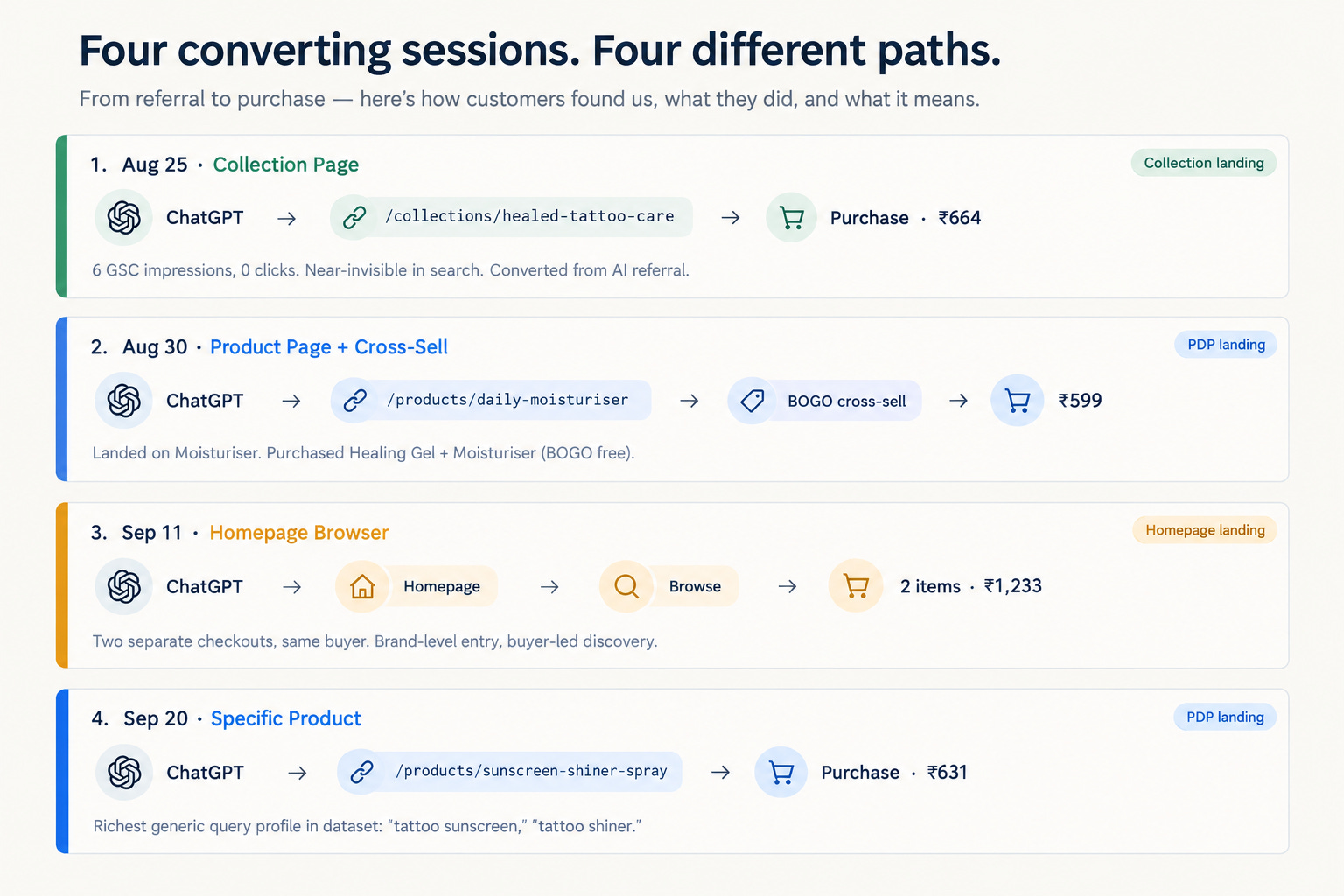
Journey 1 — August 25 · The Collection Page
Landing page /collections/healed-tattoo-care
Revenue ₹664
Surface type Collection (curated category)
Observed: A ChatGPT-referred session landed on a curated collection page — not a single product, but a shelf of related SKUs organized around a use case: healed tattoo maintenance. The session generated ₹664 in revenue.
Context: This page had only 6 Google Search Console (GSC) impressions and 0 clicks over 90 days. The queries that did appear — “daily tattoo care,” “tattoo moisturiser” — are the kind of intent a ChatGPT user might also express. But in search, this page was nearly invisible.
What this suggests: AI discovery surfaced a destination that conventional search hadn’t reached. We can’t see whether ChatGPT explicitly recommended this collection page or whether the buyer navigated there after an initial recommendation. What we can observe is that a ChatGPT-referred session entered through the collection and purchased from it.
Journey 2 — August 30 · The Product Page + Cross-Sell
Landing page /products/daily-moisturiser
Revenue ₹599
Surface type Product detail page (PDP)
Observed: The session landed on the Daily Tattoo Moisturiser product page from ChatGPT. The Shopify order tells a more specific story: the customer purchased a Tattoo Healing Gel (₹599) and received the Daily Moisturiser as a buy-one-get-one (BOGO) free item. The buyer landed on the Moisturiser page, then converted on a related SKU through the store’s cross-sell offer.
Context: The Daily Moisturiser PDP (product detail page) contains structured ingredient information — Sodium PCA, Hyaluronic Acid, Betaine, Aloe Vera — along with a full INCI (International Nomenclature of Cosmetic Ingredients) list, four usage steps, before/after images, and links to complementary products including the Healing Gel. GSC shows 278 impressions and 1 click, with queries like “ink moisturizer” (position 5.8), “tattoo moisturiser” (position 7.8), and “tattoo aftercare moisturizer” (position 5.4).
What this suggests: The referral pointed to one product. The store’s own merchandising — the BOGO offer and complementary product links — converted the session on a related SKU. The AI referral opened the door; the catalog’s cross-sell structure did the rest.
Journey 3 — September 11 · The Homepage Browser
Landing page / (homepage)
Revenue ₹1,233 (2 items)
Surface type Homepage (brand-level entry)
Shopify match: two separate orders from the same buyer — ₹569.05 + ₹664.05 = ₹1,233.10. Same buyer, two separate checkouts. This is why the dataset shows 5 purchase events across 4 converting sessions.
Observed: The GA4 session aligns with a homepage landing from ChatGPT, showing ₹1,233 in revenue and 2 items. The buyer appears to have browsed the catalog and purchased two items across two separate transactions.
Context: The homepage had 5,440 GSC impressions and 311 clicks, almost entirely from branded queries (”flaunt your ink”). In search, the homepage functions as a brand-recognition surface. The ChatGPT referral used it as a brand-discovery surface — a broader entry point than a specific product.
What this suggests: The referral pointed to the brand, not a specific product. The buyer did their own product discovery on-site. This is the equivalent of an AI sending someone to a store rather than a shelf.
Journey 4 — September 20 · The Specific Product Search
Landing page /products/sunscreen-shiner-spray
Revenue ₹631
Surface type Product detail page (PDP)
Observed: The session landed on the Tattoo Sunscreen + Shiner product page — the most specific landing in the dataset. Revenue of ₹631 is below the list price of ₹699, consistent with a BOGO discount applied at checkout.
Context: The Sunscreen PDP contains structured ingredient information (Bisabolol, Tinosorb S, Uvinul A+, Castor Oil), an SPF 50 PA+++ specification, a full INCI list, four usage steps, and before/after images. It has the richest generic-intent query profile in the dataset:
“tattoo sunscreen” — 110 impressions, position 7.8
“tattoo shiner” — 104 impressions, position 7.8
“spf 50 tattoo” — 11 impressions
“tattoo sunscreen spray” — 10 impressions
“sunscreen for tattoo” — 9 impressions
These are the kinds of queries someone might also type into ChatGPT.
What this suggests: The page that has the deepest product-intent search profile is also the page where the most specific ChatGPT conversion occurred. The page’s structured answers — SPF rating, ingredient benefits, use-case descriptions — serve both discovery systems.
The Pattern
Looking across all four journeys, four converting sessions came through three distinct surface types — two product pages, one collection page, and one homepage:
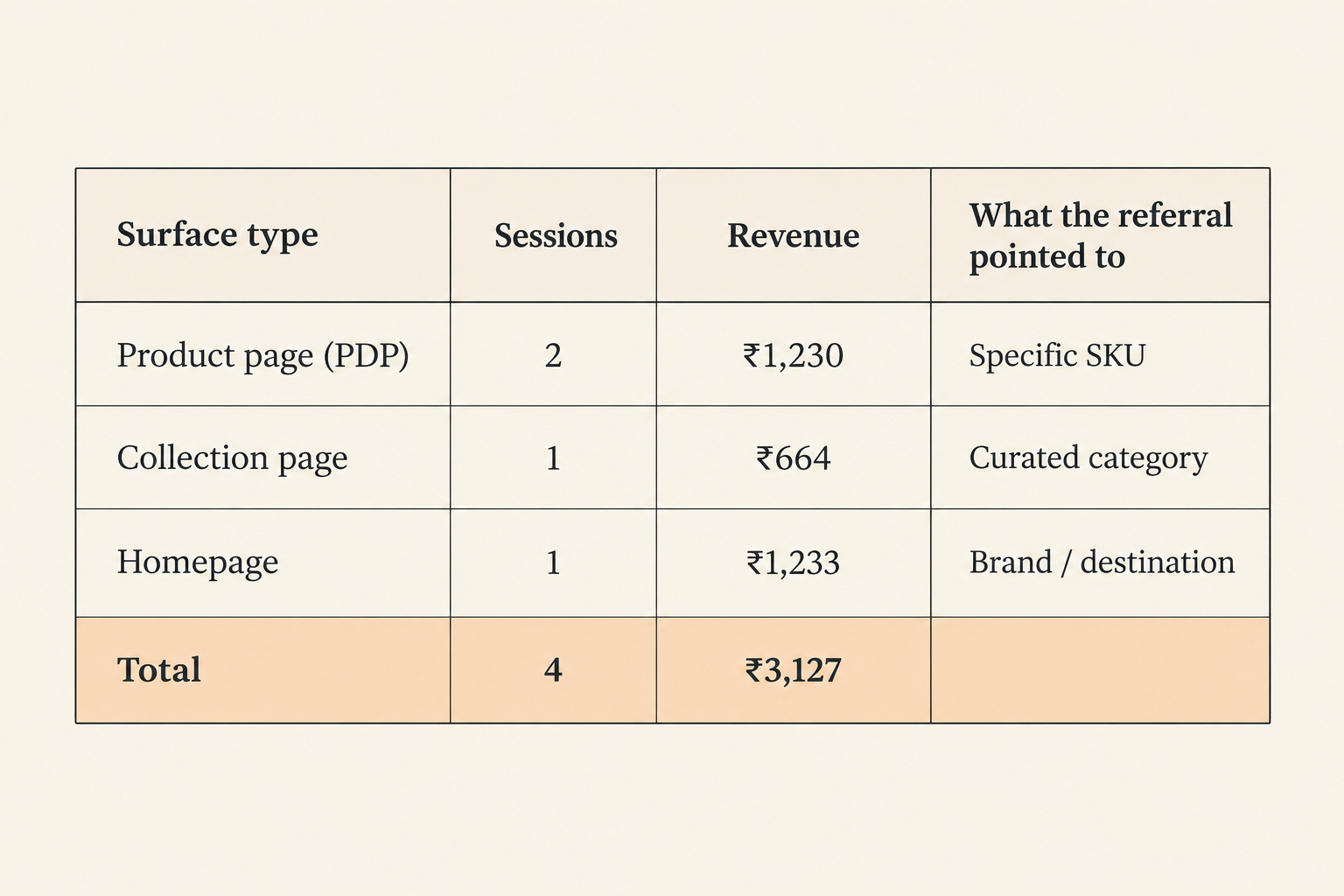
All three surface types converted. Zero converting sessions came through blog or informational content pages — though the dataset is too small to draw conclusions from that absence.
One connecting thread across the journeys: the pages that converted tend to carry what we’ll call an evidence layer — the structured product facts that a discovery system can evaluate. Ingredients with named compounds and concentrations. Taxonomy classifications that place the product in a category hierarchy. Usage steps that answer “how do I use this.” Cross-links that connect related products. This is the information a model can parse, not just the copy a shopper reads.
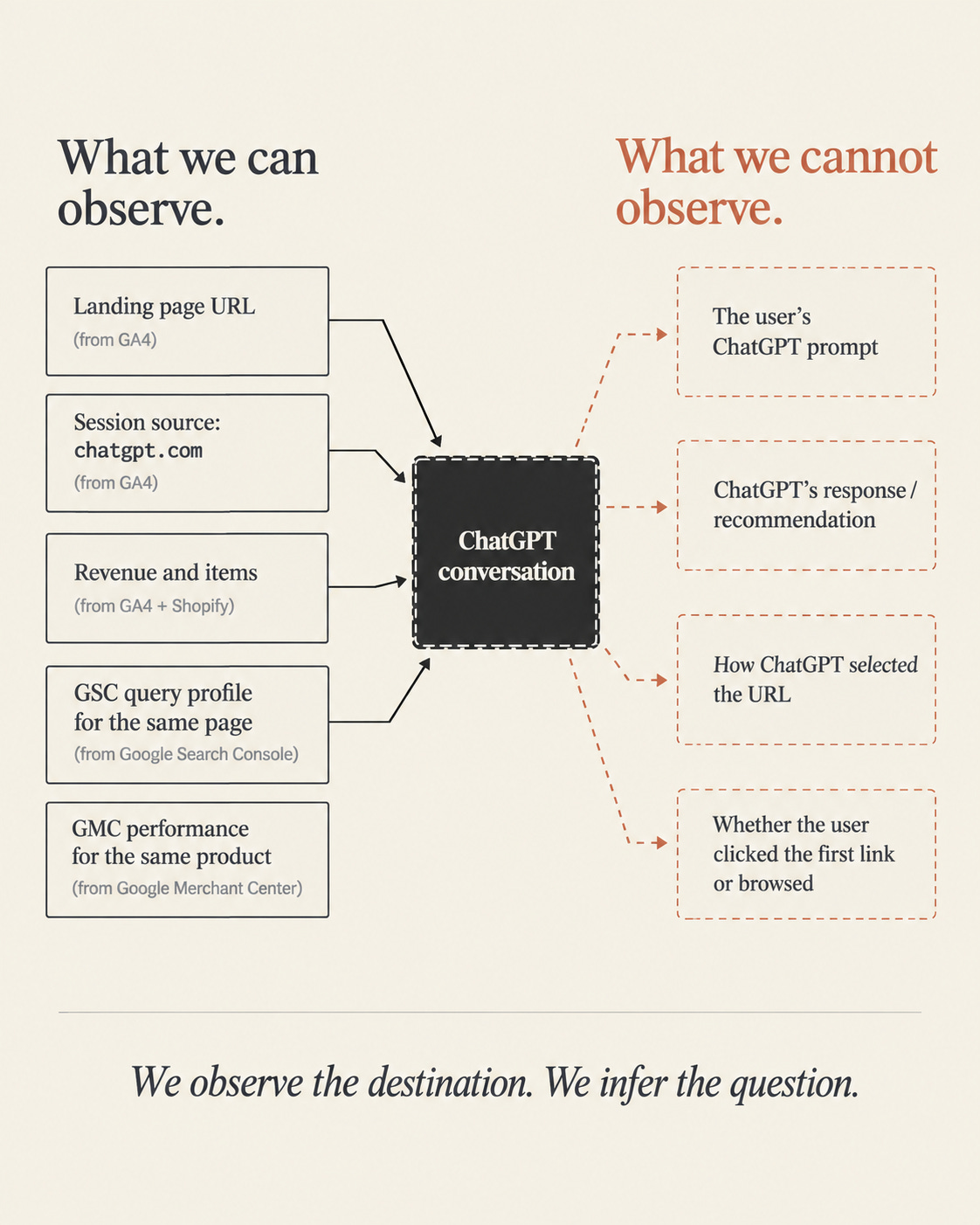
The GSC query profiles offer a triangulation point. We can’t see what buyers typed into ChatGPT, but we can observe what kinds of questions these same pages already answer in Google Search. For the Sunscreen PDP, the search queries — “tattoo sunscreen,” “tattoo shiner,” “spf 50 tattoo” — map directly to the kind of question someone might also ask ChatGPT. This is inference, not confirmation. But the overlap is suggestive: pages that can answer product-intent questions in one discovery system also converted from another.
The Cross-Surface Signal
The four conversions tell us ChatGPT can function as a commerce entry point. The cross-surface data gives us a clue about what makes a product legible enough to be discovered there.
The same two products that generated direct PDP conversions — the Daily Tattoo Moisturiser and the Tattoo Sunscreen + Shiner — are also among the store’s strongest performers across Google’s measured surfaces.
Google Merchant Center (GMC) · Jul 1 – Sep 21
Product Clicks Impressions Click Potential
Daily Moisturiser 1,213 492,091 HIGH
Sunscreen Shiner 841 508,545 HIGH
Both products have the maximum click potential rating — Google’s internal catalog quality assessment — and zero item issues. They are among the most-clicked individual products in the catalog.
One set of catalog enrichment work → visibility across multiple discovery systems simultaneously:
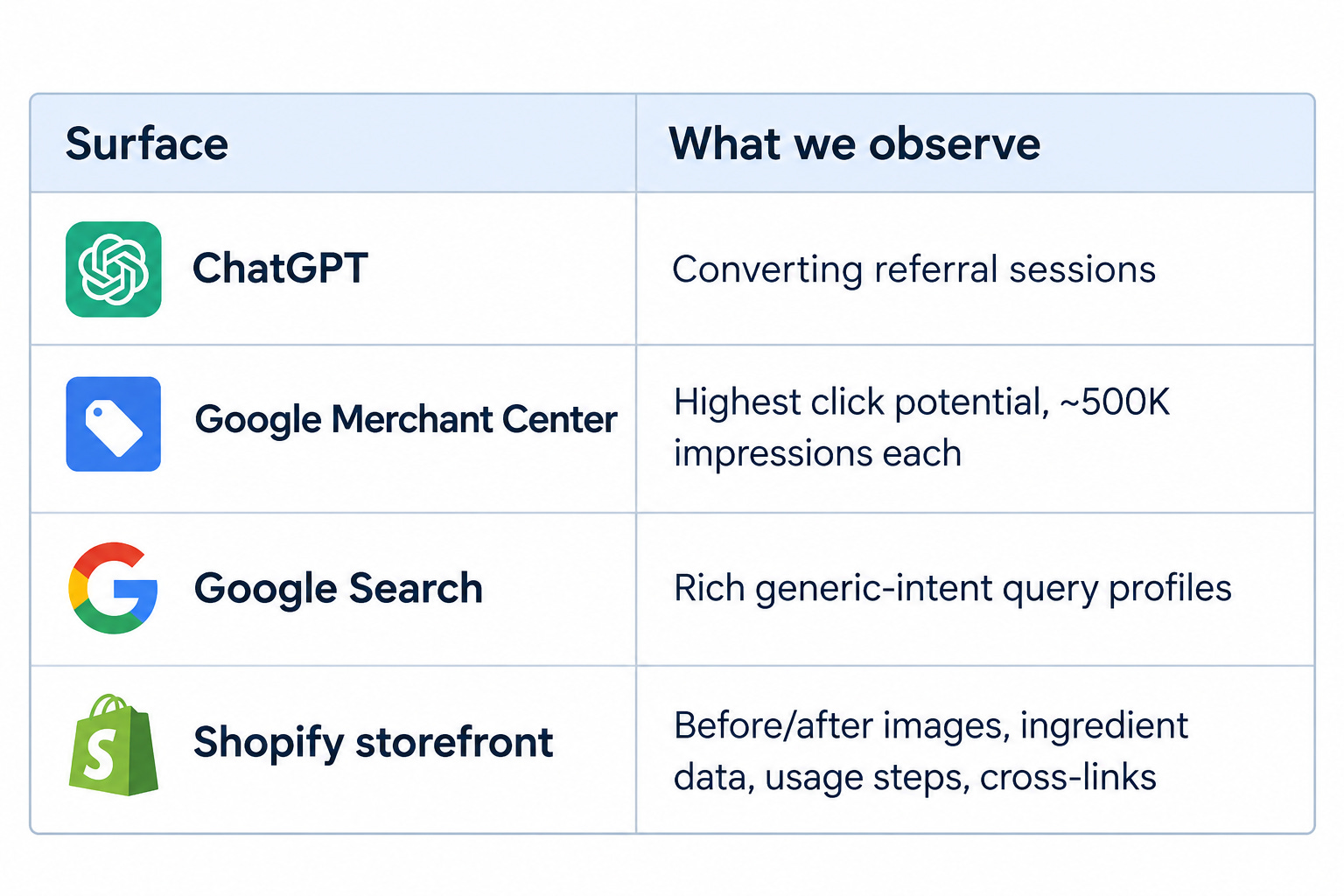
The pattern suggests a more useful unit of optimization may be the product's evidence layer — the structured facts available about it — rather than any individual discovery channel. That's the hypothesis this dataset gives us, not something four conversions can prove.
What We Cannot Claim
We cannot see the original ChatGPT prompt. We observe the destination. We infer the question.
We cannot establish causation between enrichment and ChatGPT conversions. The timeline is consistent and the mechanism is plausible, but this is an observational study with four converting sessions. Multiple variables changed simultaneously.
Our 70-session count is a floor, not a census. When referrer data is stripped — a copied URL, a context that doesn’t pass the header — the session appears as Direct. The true AI-referred count is likely higher, but we can’t measure the gap precisely.
The sample means traceability, not statistics. Four converting sessions and ₹3,127 in revenue is a signal. Its value is in the end-to-end path — AI referral → landing page → recorded purchase — not in the volume.
The New Shelf
This is the commerce payoff to the earlier New Shelf pieces.
In previous installments, we asked: can the catalog be made readable by machines? Can structured product information improve discoverability across multiple surfaces?
Now we’re looking at what happens on the other side: when an AI system encounters a product, evaluates the available evidence, and refers a buyer to it.
The catalog provides the evidence.
The model evaluates it.
The referral points to a destination.
The product page converts the session.
That path — from catalog evidence to AI evaluation to commerce — is what we’ve been calling The New Shelf.
The important shift isn’t that ChatGPT sent a few buyers to a Shopify store. It’s that some of the product-discovery process has already happened upstream by the time a shopper reaches the storefront from an AI referral. The model has encountered information about the product and surfaced it as a destination — before the buyer sees a single search result.
The question for merchants is no longer just “are we ranking in search?” It’s: when an AI model encounters our catalog, does it find enough structured evidence to recommend us?
Part 2 of this piece, "The Evidence Layer: What Made Those Products Discoverable," is coming next. It goes deeper into what made these specific products discoverable: the full enrichment detail, a comparison with unenriched products in the same catalog, measurement gaps, and the five steps this dataset suggests for any merchant starting this work.
Series Links
Google: Seven Surfaces, One Feed — The cross-surface discovery framework. This article’s cross-surface signal section builds directly on that analysis.
Your Shopify Store Has More Product Data Than AI Can See — Why product content has to be structured before downstream discovery systems can reliably use it.
Methodology note: All data was collected from the store’s own GA4, Google Search Console, Google Merchant Center, and Shopify admin between July 1 and September 21, 2026 — a window of 83 days. Flaunt Your Ink is named with the brand’s permission. The store is located in India, which is currently geo-gated from ChatGPT’s feed submission and shopping ad programs, meaning all AI referrals in this dataset are organic. Session counts reflect GA4’s settled data as of September 22.
How does AI search see your store right now?
We run real category queries across ChatGPT, Perplexity, and Google AI Mode, inspect your catalog representations, and send you a plain-language report. Completely organic; we never ask for logins or ad spend.
Request your report
Two fields. A person reviews it and emails you back within 48 hours.