Your AI visibility test probably has a location bug
Good ideas travel faster when you share them; forward this to someone who’d find it useful.
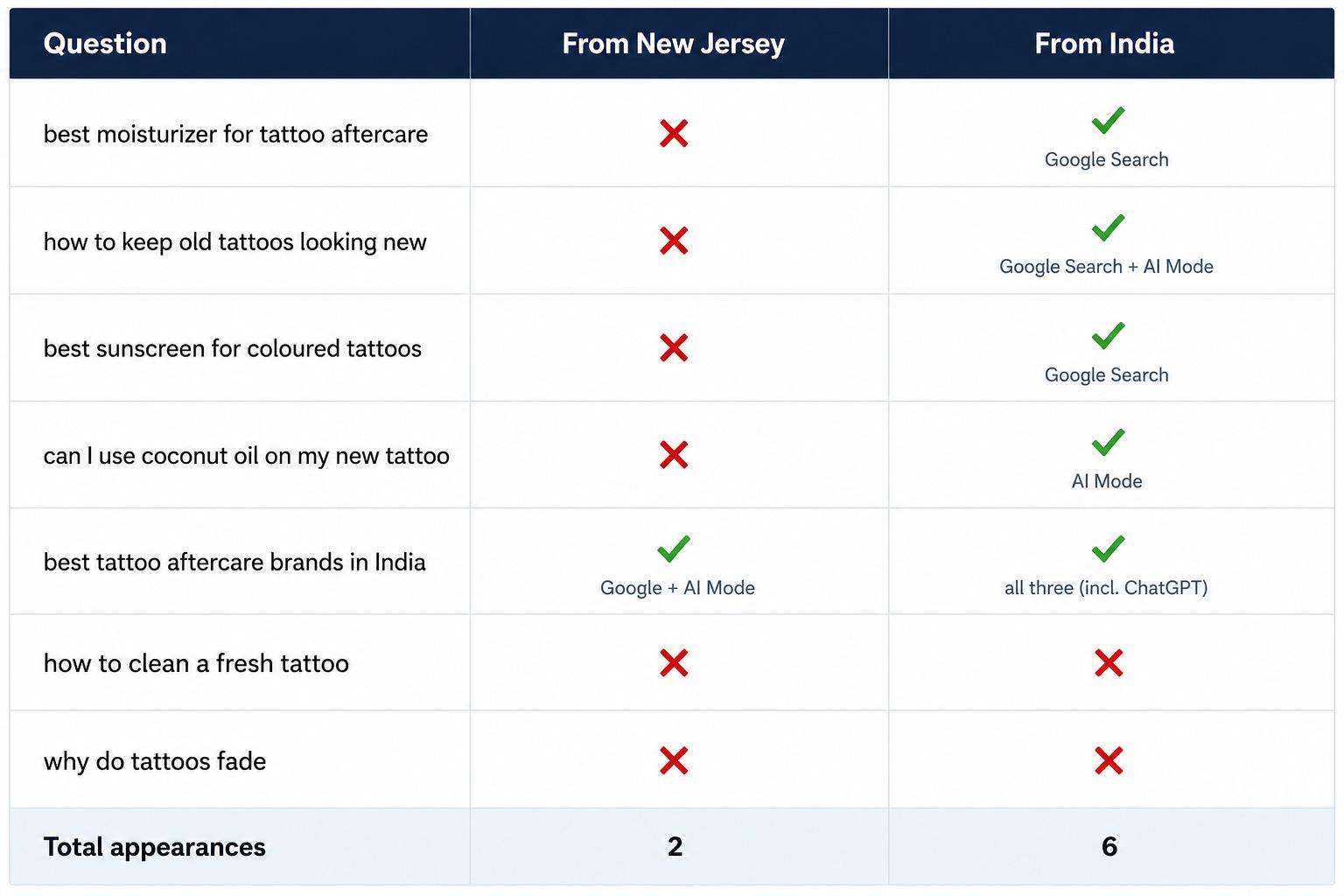
Flaunt Your Ink is the number one best seller in tattoo aftercare on Amazon India. It’s also number three. Both slots.
That ranking is Amazon’s own, computed from real sales and updated hourly. Not a badge the brand awarded itself.
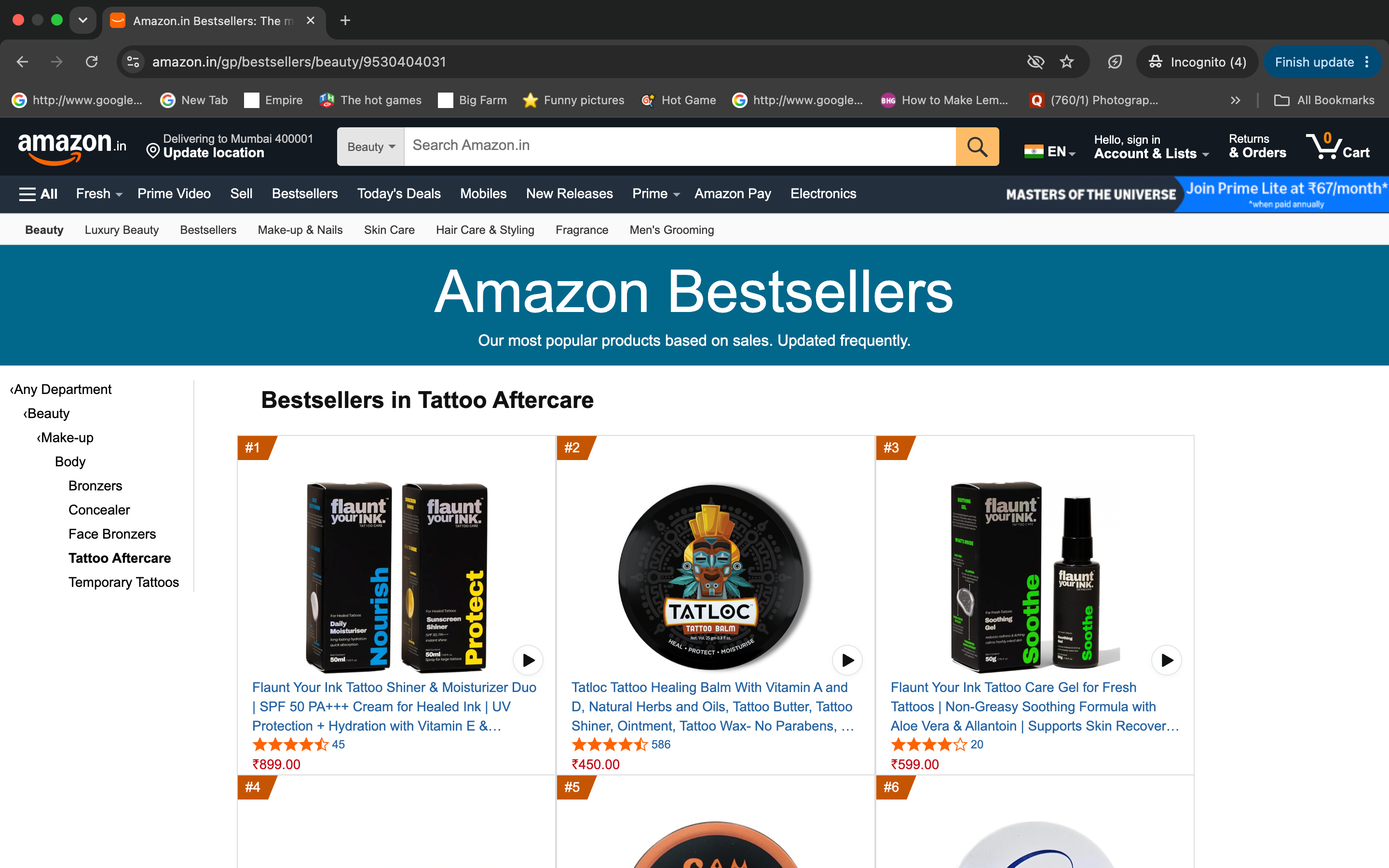
Ask ChatGPT for tattoo aftercare recommendations and it barely knows the brand exists. In my tests it named them on one question out of twenty — and only on the one that spelled out “in India” in the question itself.
My first conclusion was that AI search was broken.
That wasn’t the mistake.
There is no neutral
Here’s the assumption I’d made without examining it: that “logged out” and “location-neutral” were the same setting.
They aren’t. Clearing cookies removes personalisation. It does nothing about your IP address. An incognito browser still has a location — it just uses the one you’re physically sitting in rather than one you chose.
I’m in New Jersey. The brand sells in India.
So my “neutral” baseline wasn’t neutral. It was a US-located test of an India-market brand. I had measured, quite rigorously, how a brand that sells in Mumbai looks to someone asking from Newark.
Every test has a location, whether you picked it or not.
That’s the mistake. Everything else in this piece is how I found it and what changed when I fixed it.
The bleak first run
I ran forty buyer questions across three AI surfaces. Logged out, clean incognito session, no location set.
That felt like the rigorous choice. Logged-in sessions get personalised, and personalisation contaminates results — I’ve had runs invalidated by exactly that.
The result was bleak. Across the thirty-eight non-branded questions — the kind someone asks when they’ve never heard of you — that’s 114 question-by-surface checks. Flaunt Your Ink appeared in ten of them. It was genuinely recommended in zero.
I nearly published the bleak version.
One qualifier before moving on, because it’s the only positive signal in the study. I ran a fourth surface as well — Reddit Answers — which I’ve excluded from every number in this piece, since it only summarises Reddit threads and cites external sites roughly two percent of the time. But it produced the single genuine, unhedged recommendation anywhere in the study: a real person writing that the soothing gel “is too good.” The community warmth exists. It hadn’t reached the engines that answer buyers’ questions.
The re-run
I ran a second study with the session set to India — an Indian IP, verified by checking that prices came back in rupees and marketplace links pointed to amazon.in rather than .com. Same engines, still logged out.
This was a smaller, separate question set: twenty-one questions rather than forty. Eight were carried over word-for-word from the first run, deliberately, so there would be a matched comparison.
Here’s what happened to those eight. I’m measuring mentions — did the brand appear at all — not recommendations.
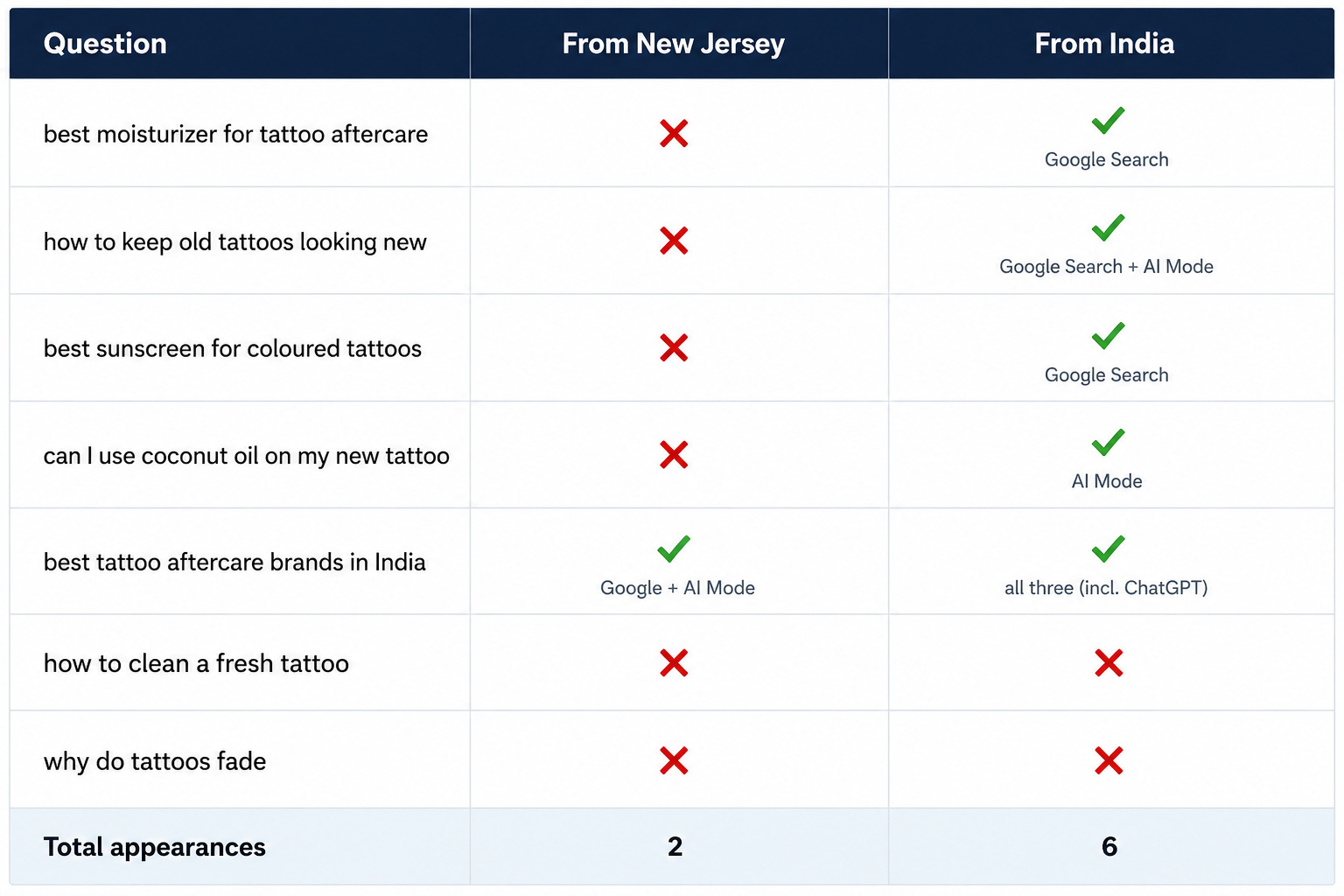
Two appearances became six.
The two that stayed empty in both runs are technique questions — how to clean a fresh tattoo, why tattoos fade. No brand should appear there and none did. Every question where a product recommendation was plausible flipped.
One caveat about that jump, because it matters. I picked those eight questions by hand, on a “most likely to show a location effect” criterion — which in practice meant questions where the brand was already absent. Those can only move one direction. A random sample would almost certainly show a smaller effect. Read the direction as real and the size as illustrative, not representative. Next time I’d draw the overlap set at random before looking at the first run’s results.
So “nearly invisible” was substantially an artifact of where I was sitting when I asked.
The part I didn’t expect
The localisation effect wasn’t spread evenly. It was almost entirely Google.
Across the twenty non-branded questions in the India-set study:
Google Search surfaced the brand on 13
Google AI Mode surfaced it on 5
ChatGPT surfaced it on 1
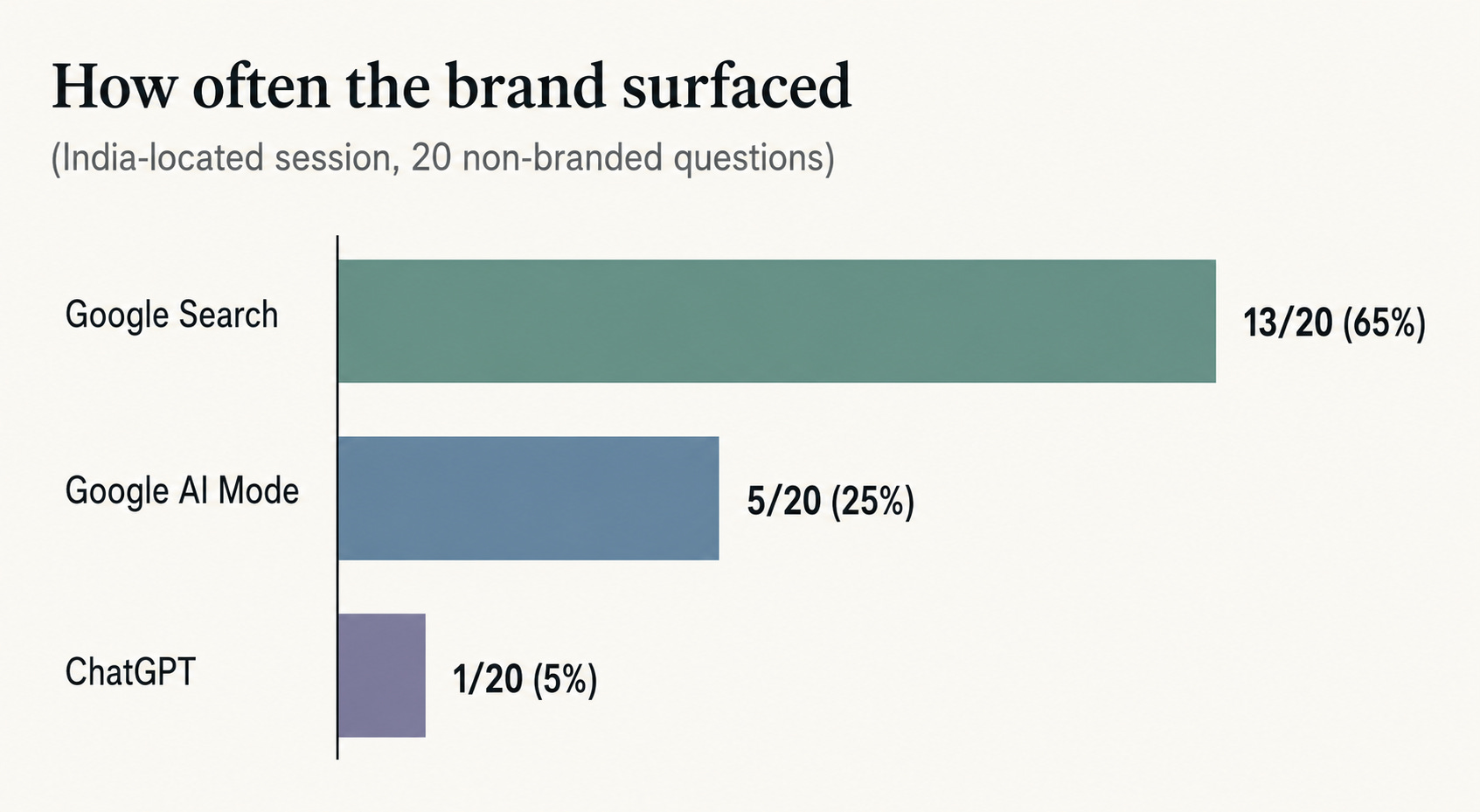
ChatGPT barely moved. On nineteen of twenty questions it reached for generic drugstore staples — Aquaphor, unscented lotion — rather than naming any specialist brand, whether the session was US or India.
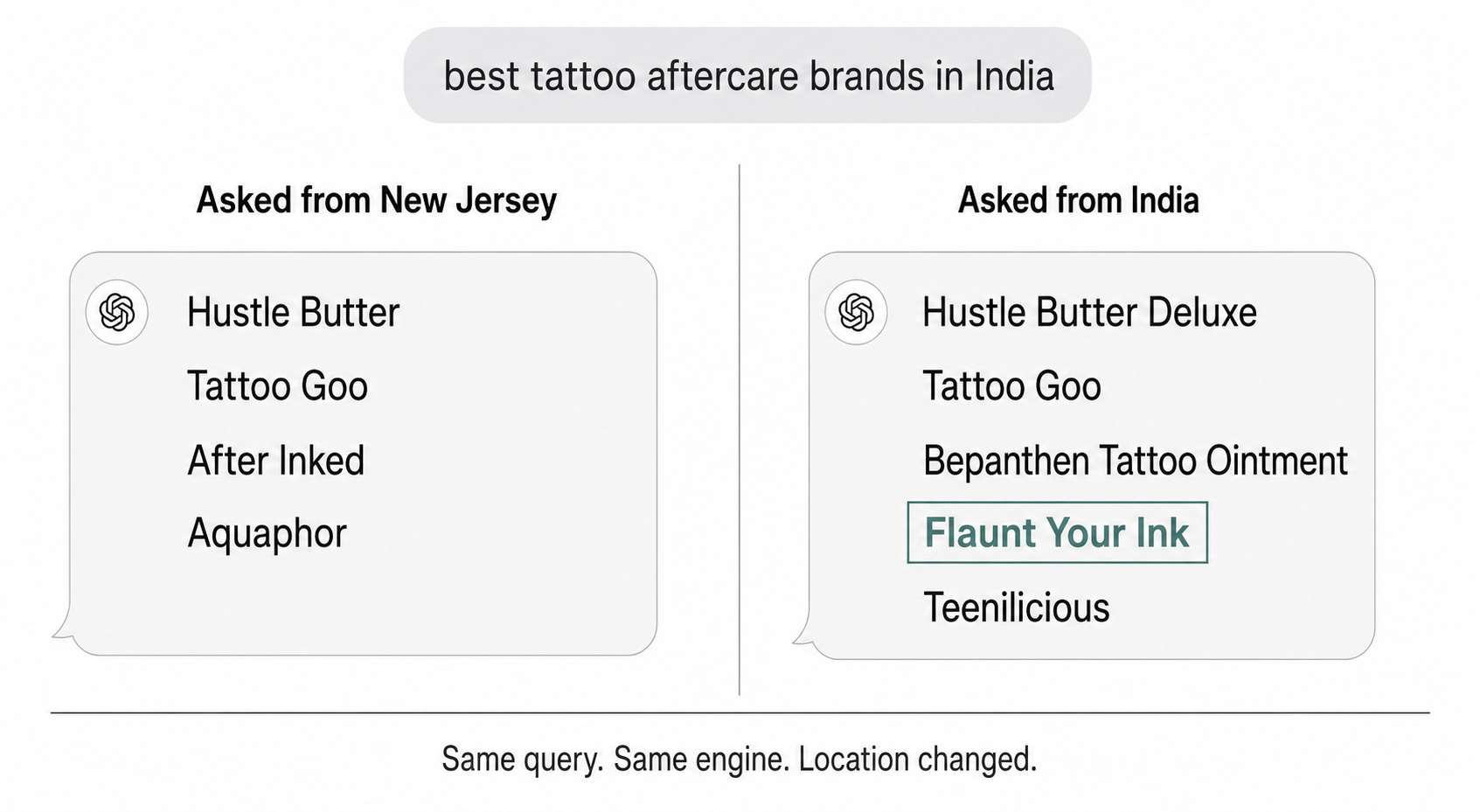
The single exception is the interesting part. ChatGPT named the brand on exactly one question: “best tattoo aftercare brands in India.” The one where the geography was written into the question itself.
That points to something more specific than “ChatGPT ignores location.” It appears to ignore where you are asking from, while responding to where you say you are. Google does both. ChatGPT, on this evidence, only does the second — which matters, because most buyers don’t name their country when they ask.
So it isn’t one visibility problem. It’s at least two, and they don’t respond to the same fix.
Why the split? I can offer a hypothesis, not a finding. Google’s surfaces look far more sensitive to geographic context — plausibly through Merchant Center eligibility, structured data, regional popularity signals, or some combination I didn’t isolate. ChatGPT appears to lean on something else, possibly third-party editorial it trusts enough to name brands from. This experiment can’t demonstrate either mechanism. It only shows that two engines respond very differently to the same single change.
What the category leader does differently
I ran the same forty questions against two competitors, scored identically.
Teenilicious, the closest India peer, earns zero genuine recommendations and has no content the engines cite. Flaunt Your Ink is comfortably ahead of it.
Mad Rabbit, the international category leader, earns ten. And the difference isn’t just frequency — it’s the form. Its blog is cited as a named source sixteen times across the set, on exactly the cold questions where Flaunt Your Ink scores zero. Why do tattoos fade. How to keep old tattoos looking new.
That distinction matters more than it first appears. Mad Rabbit isn’t merely mentioned more often — its educational content is repeatedly used as evidence. Citation is one of the main mechanisms by which AI systems introduce a brand into a conversation that started out brand-free.
Flaunt Your Ink publishes on those same topics. The articles exist. They appear not to be structured in a way that gets quoted — though I should be clear I’m inferring that from the citation pattern, not from a teardown of the content itself.
The useful shape of it: this looks like a content-citation gap rather than a brand-size gap. Mad Rabbit suggests it’s a winnable one in this exact category.
One more asymmetry
Something else stands out on that bestseller page. Flaunt Your Ink is number one with 45 reviews. The brand sitting at number two has 586.
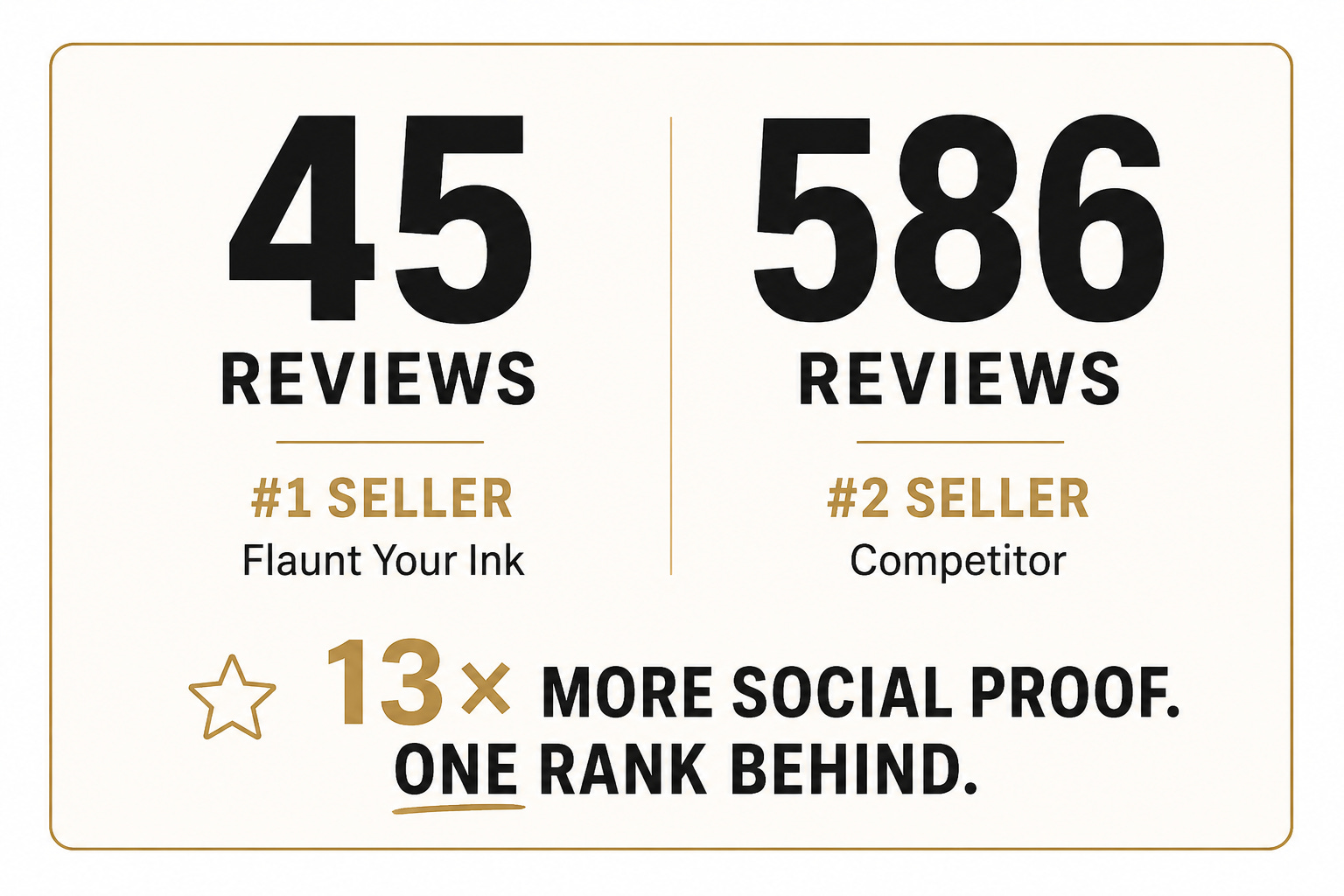
So it outsells a competitor carrying thirteen times the social proof. Commercially that’s a good problem to have. But review volume is one of the signals engines may lean on when deciding which brands are safe to name, and 45 is a thin base to infer confidence from.
I can’t prove that’s contributing to the invisibility — I haven’t isolated it, and I’d be overreaching to claim I had. It’s a hypothesis worth testing rather than a finding: does review volume function as a trust signal that makes AI systems more willing to name a brand? Right now this brand has high sales and low readable social proof, and only one of those is legible to a language model.
A measurement note worth more than it sounds
While running this I checked something adjacent: how often each engine cited any external source at all.
ChatGPT cited nothing external in 25 of 40 responses. Sixty-two percent of the time it answered from what it already knew — no source, no link, no brand.
That means citation-rate studies have two denominators, and they answer different questions:
Citations / all responses — measures overall visibility, including the responses where nobody was cited
Citations / responses containing any citation — measures competitiveness when citations were actually in play
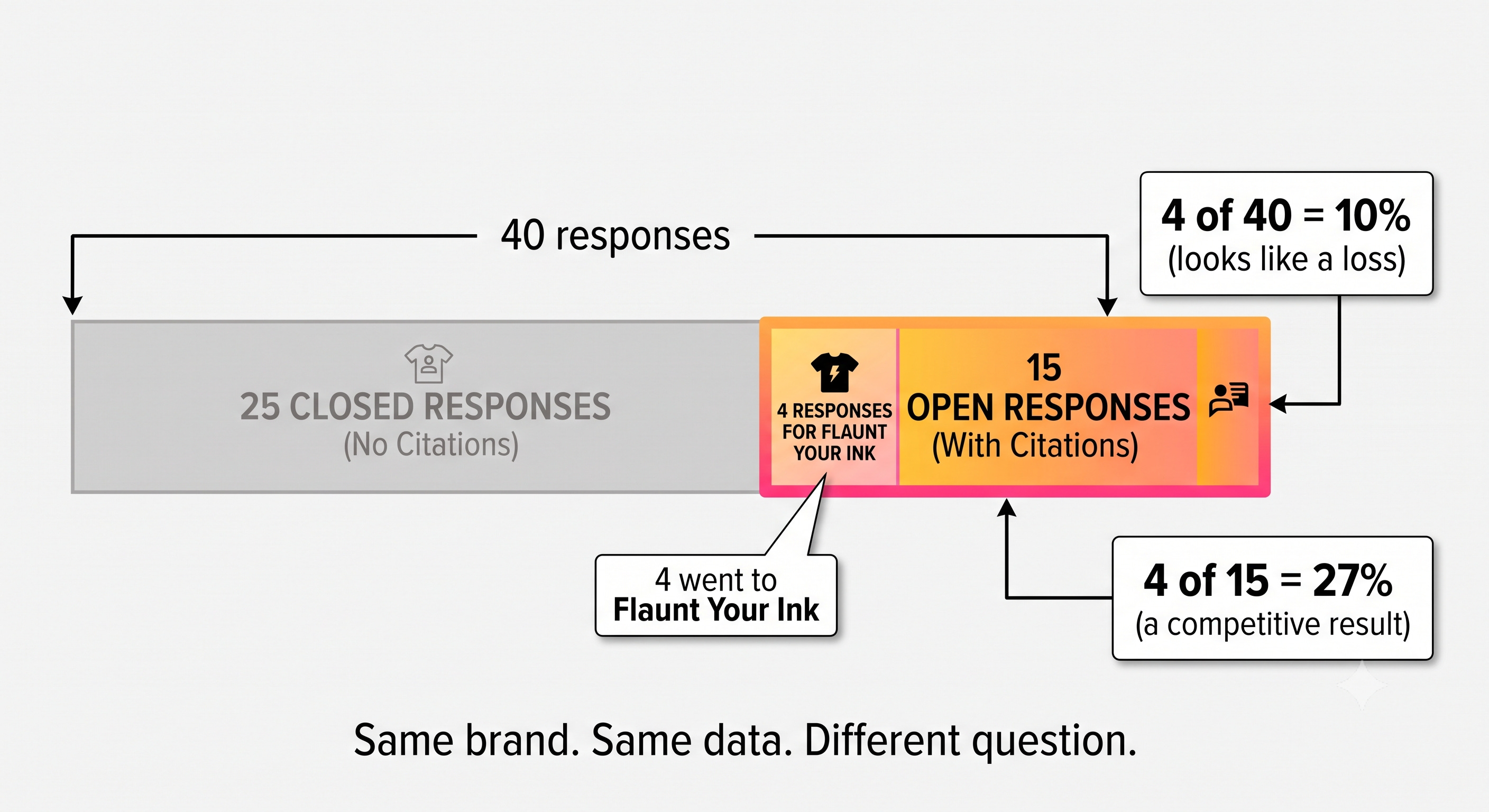
Neither is wrong. But if you only report the first, a low number reads as “the engine weighed us and passed,” when the truth may be “the engine never opened the question to anyone.” The same applies to competitor analysis: in a closed response, nobody won. Absence isn’t a loss to someone else.
Methodology
Two studies, not one study run twice.
Study 1 — from New Jersey. 40 buyer questions (38 non-branded, 2 branded) across ChatGPT, Google Search and Google AI Mode. That’s 114 non-branded question-by-surface checks (38 × 3). This is where the zero-of-114 recommendation figure comes from. A fourth surface, Reddit Answers, was run but excluded from every rate — it cites external sites only ~2% of the time.
Study 2 — from India. A separate, smaller set: 21 questions (20 non-branded, 1 branded control). Eight were carried over verbatim from Study 1 to create a matched comparison; the rest tested other things. The platform figures (13 / 5 / 1) come from the 20 non-branded questions.
Overlap selection. The eight shared questions were chosen by hand, not at random, on a “most likely to show a location effect” criterion — which biased them toward questions where the brand was already absent. This inflates the size of the observed jump but not its direction. A random draw is the correct method and is what I’d use next time.
Common to both. Logged out and incognito throughout. One response recorded per question — no repeat runs, so no noise floor. Geolocation verified per question via currency symbols and marketplace domains.
Scoring terms:
Mentioned — the brand’s name appears in the answer
Genuinely recommended — the answer tells you to buy or consider that brand for the problem you asked about; not listed among many, not mentioned in passing
Cited — the answer includes the brand’s own content as a named source or link, not silently paraphrased
What I’d defend, and what I wouldn’t
One brand. One category. One country. One measurement per question — directional, not settled. I’d want this replicated across several brands and categories before calling it a rule, and if someone runs it and gets the opposite result I’d like to know.
This experiment also doesn’t establish causation. Changing location doesn’t change one thing — it changes many at once: which marketplace results are eligible, which regional indices get consulted, what local commerce data exists, what retrieval context gets assembled. I isolated the user-visible condition, not the machinery underneath it.
What I would defend is the narrower claim: a US-located test and an India-located test produced different diagnoses of the same brand, and the difference was not uniform across engines. I asked those eight questions in both conditions and watched them change. That part isn’t inference.
If you’re running this yourself
Run both conditions, not one.
Your own location, logged out. Useful as a contrast, but be clear with yourself that this is a test from wherever you happen to be — not a neutral one.
The brand’s market, logged out. What its actual buyers see. Keep it logged out so you’re isolating location rather than reintroducing personalisation.
Deliberately overlap a handful of questions across both. That’s what turns “the numbers moved” into “these specific questions moved,” which is the difference between a hunch and evidence.
Split your questions by type before you score anything. Cold buyer questions (”best tattoo aftercare in India”) are where brands should appear. Technique questions (”why do tattoos fade”) often aren’t — and counting a brand-free answer there as a miss will drag your numbers down for no reason.
For each question, log four things: did it mention the brand, did it recommend the brand, did it cite any external source, and if so which site got the citation. That last column turns out to be the most useful one.
And verify the geolocation held. Mine dropped partway through a run — I only caught it because currency symbols and marketplace domains changed mid-set. Three questions had to be redone. Check per question, not once at the start.
The first run wasn’t wrong. It measured something real: how this brand looks to someone asking from the United States.
But nobody at this brand needed that answer. They needed to know what their Indian buyers see — and that’s the question I hadn’t asked.
Every AI visibility test answers a question. Before you trust the result, make sure it’s the right one.
I write about how AI search and AI shopping surfaces decide which products to show. Independent research, organic only — I don't touch ad spend. If you've run a similar test and got a different result, I'd like to hear it.
How does AI search see your store right now?
We run real category queries across ChatGPT, Perplexity, and Google AI Mode, inspect your catalog representations, and send you a plain-language report. Completely organic; we never ask for logins or ad spend.
Request your report
Two fields. A person reviews it and emails you back within 48 hours.