Your Shopify Store Has More Product Data Than AI Can See

Good ideas travel faster when you share them; forward this to someone who’d find it useful.
We expected to find missing product data.
We'd spent about six weeks building and measuring AI visibility for Flaunt Your Ink (FYI), a D2C tattoo aftercare brand running on Shopify. The brand sells 33 active SKUs across three lines — tattoo aftercare, men's grooming, and merchandise. Standard Shopify setup. Google & YouTube channel connected. An agency managing paid Shopping campaigns. The founder handling theme edits via Shopify CLI. Everybody doing their job.
When we assessed how the brand showed up across AI shopping surfaces, we assumed the main problem would be gaps. Missing descriptions. Empty fields. Products that hadn't been listed.
What we found was different. The product catalog knew more about every SKU than any surface representing those products was actually exposing.
The problem wasn’t missing data. It was disconnected data.
A note on what “see” means throughout this piece: we mean available through the external representations we could inspect — storefront HTML, Product JSON-LD (the structured data embedded in product pages that search and AI systems read) and downstream commerce feeds. We cannot observe what any individual AI model does with every field it receives. What we can measure is whether the information reaches those surfaces at all.
Shopify gives merchants a stronger starting point than many commerce platforms.
Your product data lives in named, structured fields — title, description, product type, vendor, tags, variants, images, price, inventory, weight. The Google & YouTube channel integration handles a significant amount of plumbing to get your catalog into Google’s commerce ecosystem. Many themes emit Product structured data on product pages automatically, though the exact markup depends on the theme.
On FYI, the baseline was solid. The theme’s JSON-LD included product name, full description, brand, images, price, availability, review ratings, SKU, and GTIN for products that had barcodes. Google’s Rich Results Test confirmed a valid Product snippet with all the standard fields.
The plumbing works. The question is what’s happening beyond the plumbing.
Traditional search largely asks whether a page can be discovered, crawled, indexed, and ranked. Product discovery through AI systems introduces a different representation problem: does the system have enough structured, trustworthy product information to understand, compare, and represent the product inside an answer? In an AI shopping surface, the product itself may become the unit being represented — as a product card, recommendation, or comparison. A product can therefore be indexed without all of its available information being exposed through the representations downstream systems receive.
Shopify has a system called metafields — structured attributes attached to products beyond the default fields. Think of them as custom columns in a spreadsheet behind each product. Ingredients, materials, certifications, skin type compatibility — anything the standard product form doesn’t have a slot for.
On FYI, we opened the metafield layer on a single SKU — the Daily Tattoo Moisturiser — and found three distinct groups of structured data that most merchants don’t know are there.
The first group was Shopify’s own taxonomy. These fields are part of Shopify’s product taxonomy system and are populated based on the product’s category assignment. For the Daily Tattoo Moisturiser, classified as “Lotions & Moisturizers in Skin Care,” the system had populated fields like cosmetic function, product certifications, product form, skin care effect, suitable skin type, and age group. Shopify had even queued five additional suggestions the merchant hadn’t reviewed. These fields live in the backend. The merchant may not know they’re there.
The second group was merchant-created. The founder had built custom metafields for the theme: ingredient feature cards (Sodium PCA, Hyaluronic Acid, Betaine, Aloe Vera — each with a title, image, and description), benefit scroller text, and product bundle contents. This is where the richest product knowledge lived — real ingredient descriptions, real benefit claims, written by the person who formulated the product.
The third group was empty scaffolding. Four Google Shopping-related variant fields existed — Age Group, Condition, Gender, MPN — all blank. We couldn’t determine from the audit alone which integration had created the definitions.
The result was three layers of product knowledge that had accumulated independently. Shopify knew about some of the attributes. The founder had entered others. The Google-related definitions existed but were empty. Nothing in the Admin made those relationships obvious, and there was no single view showing what ultimately reached each downstream system.
Data in your Shopify Admin and data in your product’s structured markup are two different things.
On FYI, we compared what was in the Admin metafields against what the theme was actually emitting as Product JSON-LD.
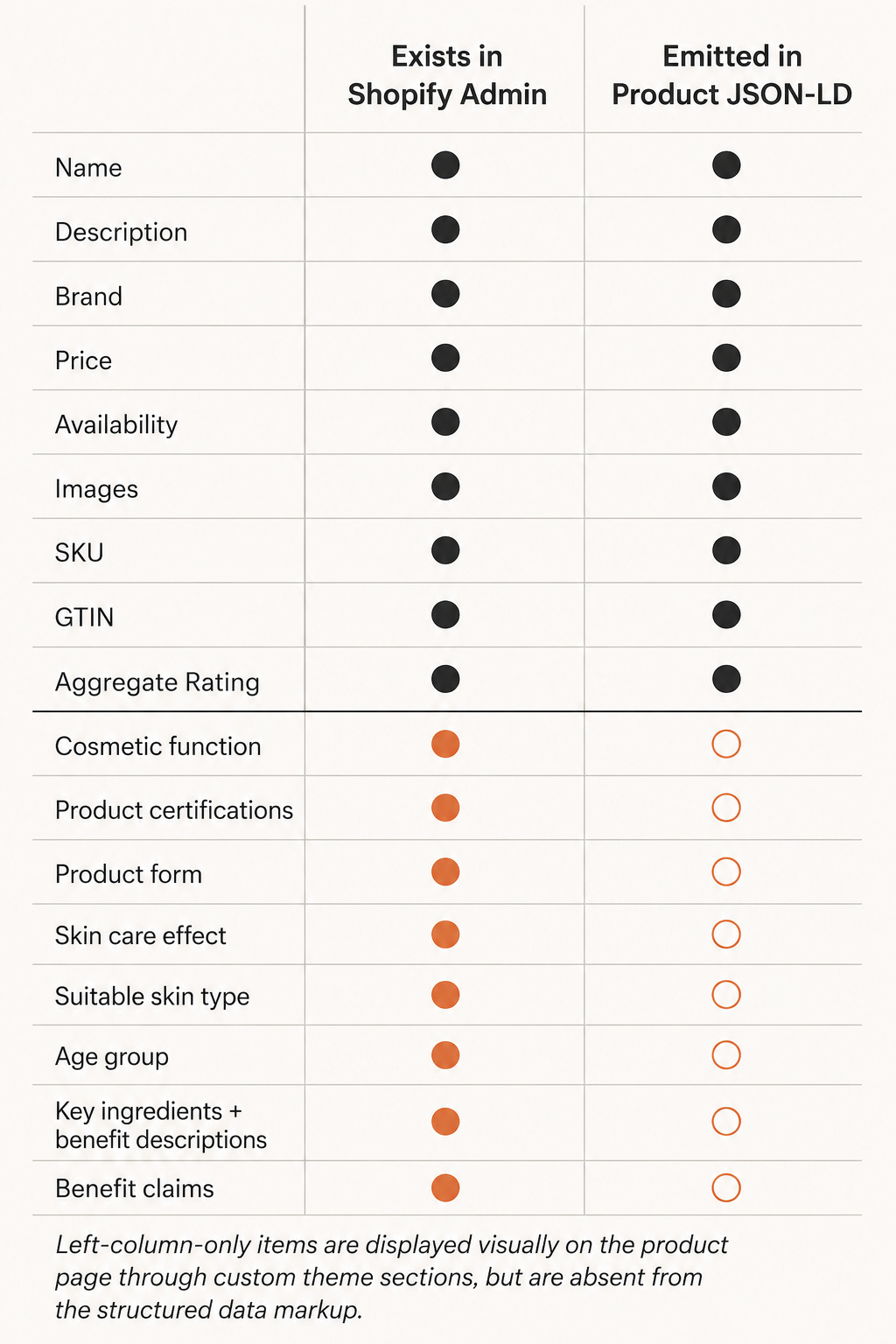
The basic product identity gets through. Name, price, availability, brand, reviews — the essentials a commerce system needs to list the product. That’s Shopify’s theme doing its job.
But the rich attributes — certifications, ingredients with benefit descriptions, skin type compatibility, product form — existed in the Admin and were displayed on the product page visually. They were absent from the Product JSON-LD. Those attributes were not part of the product representation available through that structured markup.
Here’s what that looks like for a single attribute:
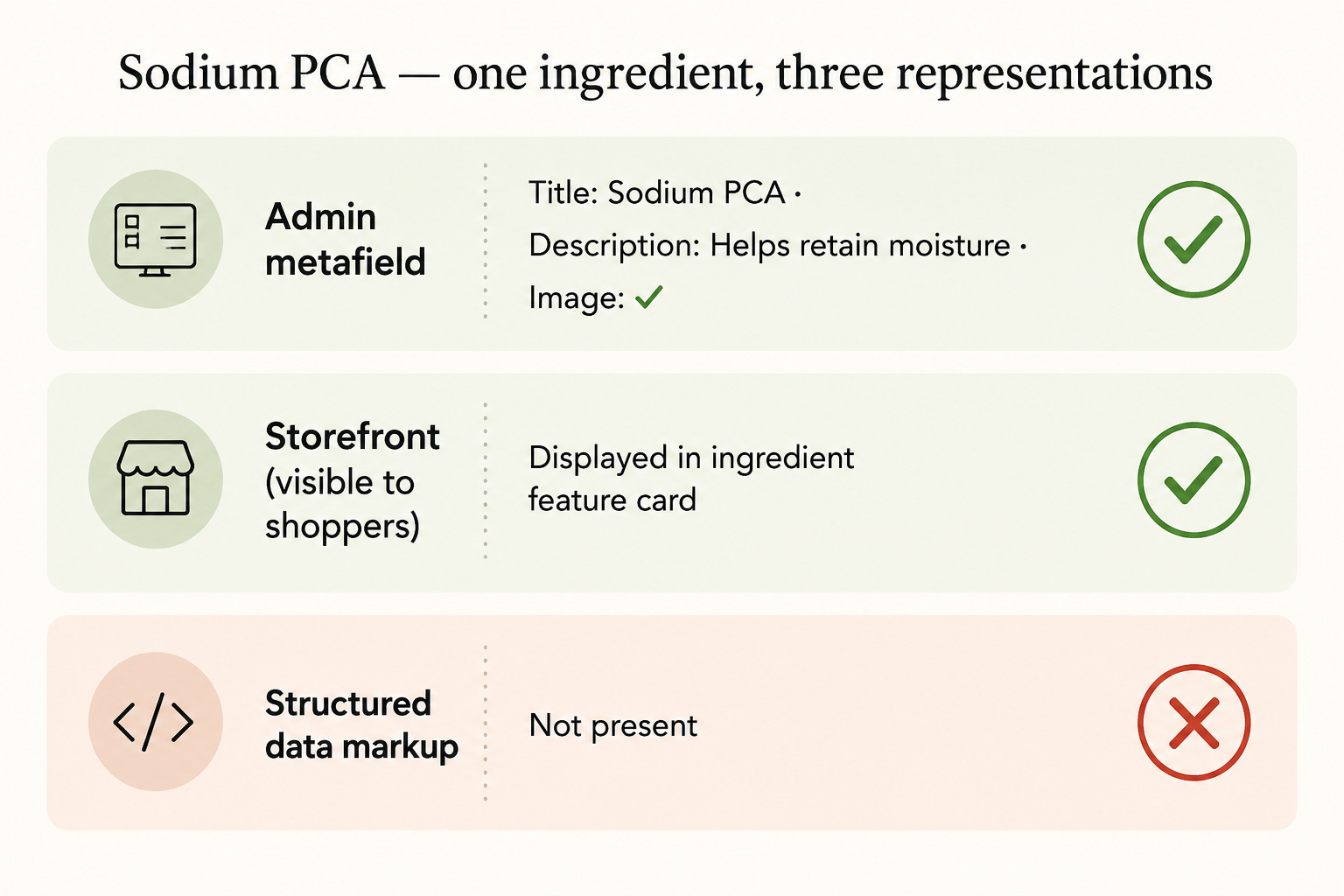
The founder wrote the Sodium PCA ingredient card himself — title, benefit description, image. The theme displays it on the product page. A shopper sees it. But the Product JSON-LD doesn’t emit it. A system consuming that structured representation would not receive the attribute through the JSON-LD.
The storefront also wasn’t the only representation to consider. The same product could look different across the storefront HTML, JSON-LD, Google Merchant Center, and Meta’s commerce integration. Each surface had its own mapping, and therefore its own potential gaps.
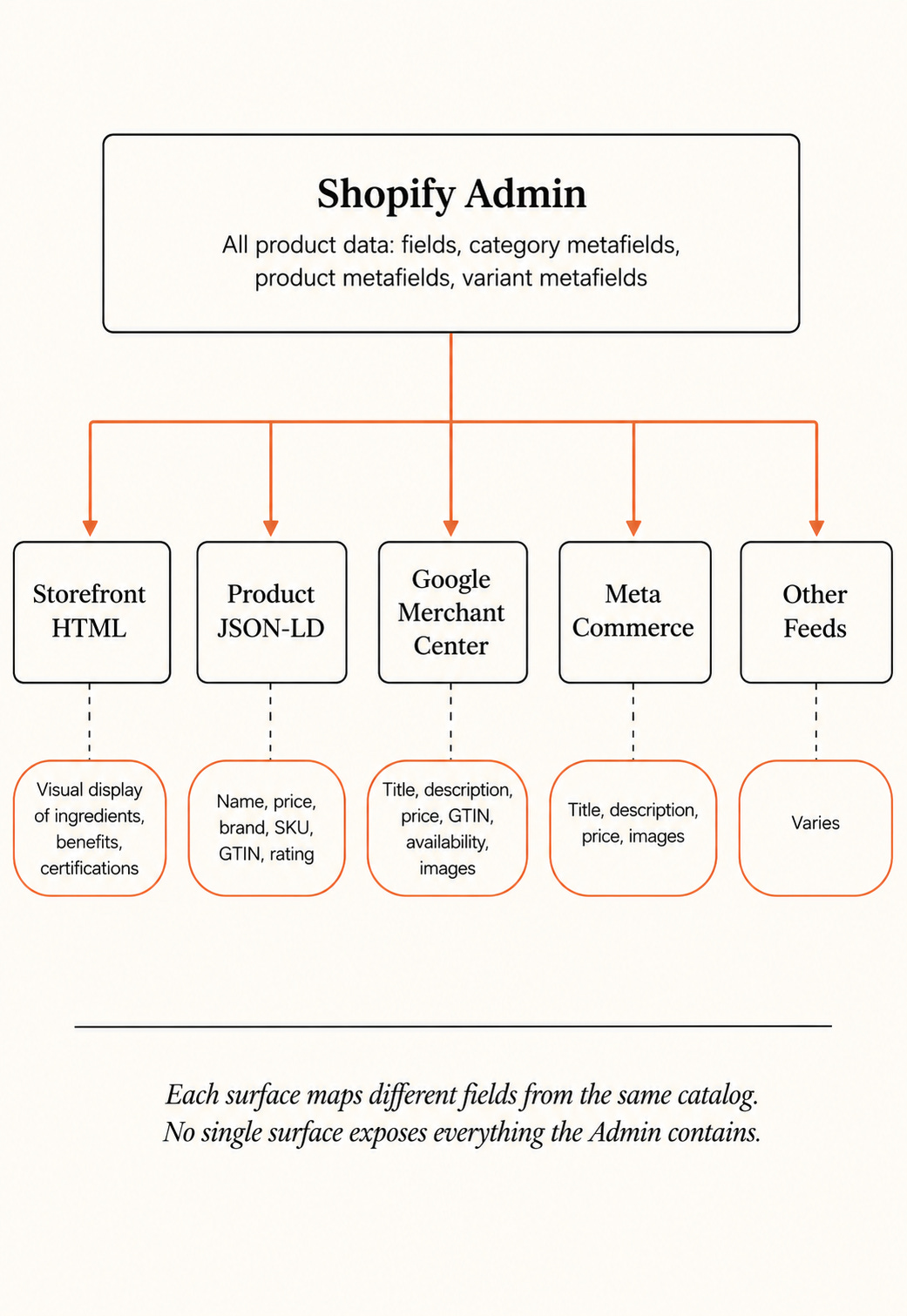
Shopify’s separation between catalog data and storefront presentation is useful architecture. But in this implementation, it created a boundary the merchant hadn’t realized needed active management. The founder hadn’t made any JSON-LD or schema.org changes since the store launched, so the theme was still emitting the structured data it shipped with. The richer product attributes had never been mapped into that representation.
The product didn’t have a data problem. It had a representation problem. The information existed in the catalog and, in many cases, on the storefront. But the structured representation we measured exposed only a subset of it.
The question for Part 3 is who owns that boundary — and what happens when nobody does.
Part 2 opens one of those downstream surfaces — the Google Merchant Center feed — and documents what was actually inside a 33-product catalog. Coming next.
Part 3 covers who owns each layer of the pipeline, and what happens when the answer is “nobody.”
What this case study measured
Catalog: 33 active SKUs across three product lines (tattoo aftercare, men’s grooming, merchandise)
Admin: Shopify product fields, category metafields, product metafields, variant metafields
Storefront: Live product pages on flauntyourink.com
Structured data: Product JSON-LD via Google Rich Results Test
Feed: Google Merchant Center (native Shopify sync + supplemental feed)
Audit window: Approximately six weeks, July–August 2026
What it did not measure:
Whether each AI system ingested every field.
Whether adding missing attributes to JSON-LD changes AI recommendations.
Whether structured data exposure alone causes changes in AI visibility.
Causal impact on sales or citations.
How does AI search see your store right now?
We run real category queries across ChatGPT, Perplexity, and Google AI Mode, inspect your catalog representations, and send you a plain-language report. Completely organic; we never ask for logins or ad spend.
Request your report
Two fields. A person reviews it and emails you back within 48 hours.